
Business Models for Startups
Fresh from vacation come two key takeaways: think epically big and don’t waste time re-inventing your business model. Here are 16 proven business models that will live up to your vision.

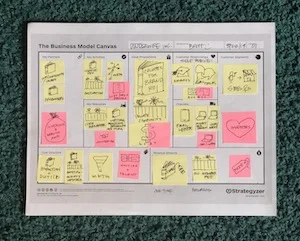
Early version of a Business Model Canvas for Underwire
Money Making
I spent a considerable part of Q2 obsessing over how to make money with Underwire.
The Business Model Canvas above is my first iteration. I shared it with advisors and confidants. I simplified it to two revenue streams. I set goals and made plans.
Then I went on vacation. I didn't think at all about models. Instead, I thought about scale. I visited eastern Europe and witnessed the ruins of the Holocaust and its impact on the cultures and landscapes of Berlin, Warsaw, Krakow, Prague, Nuremberg, Munich and Berchtesgaden. The scale of Hitler's vision was utterly astounding and sickening. He went as big as inhumanely possible.
Then I experienced the scale of Hell's Canyon, North America's deepest river gorge, and the Oregon coast at Bandon. These are epic landscapes that prove who's in charge. Not us. There are much bigger forces at work. Mother Nature being one of them, and oh baby is she ever going to work us over in the years ahead.
Out of this vacation came key takeaway no. 1: Men think big.
Women do, too, but we all know that the money goes to help men realize their big vision way more than it does to women. We have got to create more space for women to realize epic, blow-new-markets-wide-open visions.
Key takeaway no. 2: There are proven ways to make money. We don't need to get tricky with our business models.
I came to this second takeaway last week at lunch with Dave Parker, who kicked my ass with the insight that there are only 16 startup revenue models. Your idea for a company may be unique and huge but how you make money isn't.
Dave created a 22-page Slideshare deck that eloquently outlines the purpose of a business model with examples of the 16 options. Each option has use-cases, key metrics and succinct challenges and notes based on Dave's extensive career as an entrepreneur and investor.
BTW, Dave is one of the good guys working to support female founders as an investor and advisor. I see him around Seattle at the female-focused events, and he developed a program called the 6 Month Startup: From Ideation to Revenue. The fourth Seattle cohort begins this Fall, and he's taking the program to cities around the world.
If you've got your model nailed, brava for putting in the work and finding product-market fit. Run with that. However, I suspect many of us have anxiety about our models. Use Dave's examples to think about how you might pivot or add another model to your mix to diversify your income streams.
One other practical tool is the Business Model Canvas from Strategyzer. I love how it requires you to simplify and visualize your model by looking at how you'll create, deliver and capture value to your customers. Download a blank canvas here.
I'm trained in the Strategyzer methodology. I'm happy to coach you through scenarios if you want to buy a couple hours of my time. Shoot me an email.

Namaste, Bitches!
I'll be talking about this yoga retreat until it’s booked because I believe it in that much. For bendy-flexy types, it’s the trifecta—yoga, supportive women and incredible food. With a cherry of a space on top.
Last January, 13 amazing women gathered for one day. We had a VC, a couple of seed stage startup founders, many bootstrappers and a CEO of an established company expanding into new markets. You get a full day with the highest caliber women. There is no other networking like this in the Seattle area.
Underwire Yoga Retreat
Sunday, Oct. 20, 2019
8:30 am - 5 pm

Techstars Accelerator
Learn more about Techstars Accelerator program and meet two female-identifying CEOs from the 2019 Seattle program.
One way to take your company to the next level of development is to join a startup accelerator. These organizations, with mentor networks and financial contributions, help young companies leverage initial successes, fine tune business models, and demo their products for potential investors.
If you’re considering an accelerator, here’s a helpful tool for understanding your options:
Seed Accelerator Rankings Project
Also known as SARP, this group is led by researchers from Rice University, the MIT Innovation Initiative Lab for Innovation Science and the University of Richmond. They track quantitative and qualitative factors like startup outcomes and founder interviews with the intent to encourage research about the seed accelerator phenomenon, its effects, and its prospects for the future.
Encouragingly, SARP is led by two women—Yael Hochberg and Susan Cohen.
One of the top accelerators on SARP’s list is Techstars. Samantha Bell from the Techstars Seattle team wrote the article below, and conducted a short Q&A with two female founders in the 2019 Techstars Seattle class— Surbhi Rathore of rammer.ai and M.H. Lines of Automaton.
Read about their Techstars experiences here:
Techstars Seattle x Underwire
Comprehensive support. Investor access. Accelerated knowledge. These are the three main reasons why startups choose to exchange 6% equity of their company (issued as common stock) for $20,000 when joining a Techstars accelerator. Upon acceptance, every company is offered a $100,000 convertible note.
To date, out of the 3,315 individuals who have gone through a Techstars Accelerator and self-selected their gender as male or female, 477 of those individuals, or 14%, identified their gender as female.
Though today’s startup ecosystem is predominantly male, research shows that companies with female founders often outperform their male peers. Through its network of hundreds of companies and startup programs worldwide, Techstars hopes to influence this on a large scale.
In 2015, Techstars launched the Techstars Foundation, a non-profit created to improve opportunities for women and underrepresented minorities in tech. So far the foundation has supported 15 non-profit organizations and hundreds of underrepresented entrepreneurs.
Roots of Techstars accelerator programs
Techstars is the worldwide network that helps entrepreneurs succeed. Since its founding in Boulder, Colorado in 2006, Techstars has expanded to 150+ countries with 10,000+ mentors in its network. To date, Techstars has invested in 1,700+ companies and has raised nearly $7 billion in funding. With the addition of the Techstars Starburst Space Accelerator, Techstars now has 46 accelerators to consider when applying.
Do more faster: In 3 months
Techstars helps startups do more faster, every day, by surrounding them with people who will mentor, inspire, and challenge them. Within the first month of the three-month accelerator, startups begin growing their network during Mentor Madness week. From these hundreds of interactions, companies select three to five lead mentors who help with product development, market fit, and provide valuable introductions.
In addition to working with their lead mentors, startups work with the Techstars Managing Directors to hit their milestones and gain traction. Over the course of the program, startups will determine their fundraising strategy and prepare to meet with investors, allowing them to accelerate their business.
So what does all this hard work lead to? At the end of the program, companies can show how much progress they made at a culminating demo day. The startups spend the last month of the program crafting and perfecting their five-minute pitch to investors, family and friends to present at this celebration.
Techstars doesn’t stop once the program ends. Companies can leverage the network post program through events and access to a deep well of resources for life.
Want to submit your startup to Techstars?
Application periods vary for Techstars’ different accelerator programs. Information around what programs are accepting applications, and when, can be found on the Techstars website.
After applications close, each program spends about seven weeks getting to know more about the applicants’ ideas, teams, and market progress. The final group of companies accepted into each accelerator is typically notified within eight weeks from the application closing date.
Make sure you pick a program in a location that will give you the best opportunity to build the right network with the right mentors. Who knows - you may end up relocating your company there once the program ends!
For a full list of programs, click here.
For tips from Techstars’ Managing Directors, click here.
Preview application questions here.
Techstars Seattle Accelerator
Techstars launched Techstars Seattle Accelerator in 2010 with ten companies, five of which went on to be acquired. Of the Techstars top 50 companies, six went through the Seattle Accelerator, including Zipline, Outreach, Remitly, Leanplum, Realty Mogul, and Skilljar, with the latter two having women CEOs.
Combined, Techstars Seattle Accelerator alumni have raised nearly $900 million, and now employ thousands of people in the Pacific Northwest and around the world.
The Techstars Seattle Accelerator receives hundreds of applications based on the opportunity to build the right network with the right mentors, and female founders are highly encouraged to apply. There have been 29 founders who identified their gender as female that have come out of Techstars Seattle.

Richa Prasad: How to grow fast without VC funding
Richa Prasad, CEO and Co-Founder of Coach Viva on the strategic mindset shift that can help you drive profitability without venture capital.

Richa Prasad, CEO and Co-founder of Coach Viva, details how to shift your business model from growth to profitability and seven steps to grow fast without VC funding.
Editor’s Note:
This is not fast, snackable content. This is control-your-own-damn-destiny content.
Underwire is honored to feature the writing of Richa Prasad. A former AI engineer at Microsoft, Richa co-founded Coach Viva with Lucy Liang. This article details Richa's journey through early stage customer acquisition for her AI Health SaaS startup. The strategy and formula she details will work for most companies—digital products, ecommerce, professional services, etc.
With women-led businesses getting less than 3% of venture funding, no one is coming to save us. If you're serious about building a viable business, study this article and apply the lessons to your marketing mix.
I come from a deep product background. Electrical engineering. Computer science. Internship at Philips Semiconductors before they shut down. At Motorola before they got bought by Google. A full-time gig at Microsoft working first on Visual Studio and then Cortana.
I read widely about all aspects of tech. I dogeared the entire Lean Startup series and books of similar ilk that you’d find on top of Product Hunt Books. I subscribed to Y Combinator and the whole Silicon Valley advice engine, and at some point I began to believe that I understood what are all the pieces of running a business in breadth, even if not in depth.
I left Microsoft to fill a gap I see in the personal health and fitness market where coaches cost exorbitant amounts of money and yet aren’t available at the very moments when people need them the most - moments of failure like when you’re shame spiraling from eating far too much, moments of indecision when you’re standing in line to order your food and don’t know what’ll keep you perfectly on-track, and moments of exhaustion when the journey feels far too hard and you want to give up.
A year into running my company, Coach Viva, my cofounder Lucy and I ran into what we all grapple with - growth. Our word-of-mouth was solid but it was nowhere close to a viral coefficient of 1, the threshold beyond which you can be assured that your product will grow fast on referrals alone; no other marketing channels needed. We tried ads, partnerships with other businesses in the health niche, a tool to attract leads, a pilot with Amazon Benefits, an in-product feature to promote referrals, and much more, but still we struggled with getting a steady stream of incoming customers.
It was in the midst of Summer 2018 while I read, watched and listened to marketing advice from literally anyone who makes their entire living online when I stumbled upon this whole world of entrepreneurs creating 8+ figure businesses without VC funding. They said things that made me realize there is a whole other way of doing things outside of what Silicon Valley talks about.
This story is my distillation of what I have learned with emphasis on the parts that completely changed how I think about building a business.
I am very early in implementing what I’ve learned so you aren’t going to find a “it works for me, let me show you how it’ll work for you” story. My goal isn’t to give you proof. My intention is simply to expose you to a different way of building a business than what gets airtime in tech circles, and leave it to you to decide if it’s for you.
Part I: To fund or not to fund
When I tell someone I am a founder, their first question is, “What does your business do?” followed immediately by, “How much funding do you have?” Not a surprising question given that I see one month old tech companies circling funding events.
I have to admit funding is one piece where what made sense to me versus what I saw happen around me felt disconnected. Not so much in “Why one needs funding” but more in “When one needs funding.”
Lucy and I felt we were in a niche where at our early stage, VC money didn’t seem like a necessity to finding product/market fit or fighting off competitors. We also weren’t sure if we were ready to commit to growing at the crazy pace VCs expect. And lastly but most importantly, the process of getting funded seemed like a huge distraction from what we needed to focus on most - building traction.
This brought up the question of how do we grow fast enough that we don’t run out of our meager, bootstrapped runway?
As you may or may not know, SaaS businesses are notoriously slow going for the first 3-4 years. This is especially true for a B2C SaaS model like ours where each sale is in 2-3 figures, not the 4+ figures each B2B sale brings in. Add to this that we’re selling weight loss coaching where churn is naturally high due to customers’ life priority changes and meeting the goal they signed up for.
Searching for answers to these existential questions far and wide, I came across Russell Brunson, who grew his company ClickFunnels from 0 to 360M in 4 years without any VC funding. I started digging into how he did it and that’s when I learned what I’m about to share.
Part II: The foundation of profitability vs. fast growth
There are 3 foundational blocks to understand about his success. The first two blocks describe the business and mental sandbox you’ll be playing in should you choose to follow his approach. Use them to judge if this is the right path for you. The last block lays down the strategy to follow if you decide on this path.
Business sandbox: Constraints you agree to build your business within.
Mental sandbox: Silicon Valley mindsets you agree to discard.
Your strategy to growing fast without VC funding.
Business sandbox
Firstly, let’s talk about which businesses aren’t a fit for this path. If your company is in a commodity-like industry that doesn’t inherently have enough differentiation on day 1, then what I’m about to share won’t work for you.
Social networks and ride-hailing services are two examples of businesses that don’t fit this model. These types of businesses rely on lots of cash to grow fast and monopolize a market before their competitors, and that monopoly becomes their lifeline. They need VC funding to accomplish this.
Compare this to a service like Coach Viva where there is inherent differentiation in coaching services. You pay Tony Robbins a whole lot more than a life coach off Yelp even though they both provide the same service. In contrast, Lyft and Uber are largely interchangeable and rely on coverage and price wars to attract and keep customers.
Second, your focus is to build a profitable business, not a high valuation business. You can always decide later that reaching escape velocity has become critical to your business and you need to attract VCs, but when you’re in midst of pursuing the strategy I describe in foundational block #3, you’re primarily tracking profits, not pure growth.
For what it’s worth, if you choose to not pursue the VC path ever, it doesn’t mean you won’t have massive impact on the world. Perhaps the most famous example of such a person in the Silicon Valley bubble is Gary Vaynerchuk. He's funded many startups including Facebook, Twitter and Venmo to name a few, but his own company, Vayner Media, has never taken any VC money.
Lastly, non-VC backed companies grow fast - ClickFunnels and Vayner Media for example - but they aren’t going to grow as crazily fast as VC-backed companies because they don’t receive overnight millions of dollars to burn. Comparing the two is like comparing a natural bodybuilder to a steroid-fueled one.

Natural / Non-VC vs. Steroid / VC
Mental sandbox
All the mindset shifts I am about to list hinge upon the change in business model focus: profitability, not pure growth. If you’re going after pure growth, Silicon Valley advice is the perfect advice for you. However, if you’re following this fast bootstrapped path, then you will need to make the following mindset shifts.
The first mindset you’ll need to shift is your attachment to the narrow scope of the problem you’re trying to solve. Instead, try to serve your market in whatever way possible.
Let me explain.
When I first started Coach Viva, I was attached to making real-time weight loss coaching affordable for the masses. This is exactly the type of focused problem that startups get funded for.
But let’s be honest:
Not everyone who is trying to lose weight needs coaching.
This sort of business naturally has high churn because the point of coaching someone is to help them become independent.
If I poke my head up and look around beyond solving coaching, I see a whole slew of customers who'd pay for kick-ass DIY weight loss tools and courses. Bonus: I will become profitable, thereby extending my bootstrapped runway, far more quickly if I try to serve my market in whatever way possible like building the aforementioned tools and courses, and thus disconnecting my business’ success from sales of my coaching service alone.
This brings me to the second mindset you’ll need to shift: sell (almost) everything. Most VC-backed businesses are set up to revolve around one main paid solution with different pricing tiers while everything else gets distributed for free.
Now I’m not saying charge for content marketing. You need to have free relationship-building stuff out there, but don’t only charge for your main solution. For example, at Coach Viva, we sell courses and we’ll sell DIY tools soon, even though our “main” product is coaching.
I touched upon the third mindset briefly just now but to call it out explicitly, don’t marry yourself to selling only software. This is a product-person mindset trap. Sell whatever type of solution your audience needs. In our case it’s also courses and physical workbooks. You're seriously under-serving your market if you are married to only selling software.
And the last mindset you need to shift is thinking your product is not your offer. Those are two very different things, and to build your offer, the different solutions I’ve been talking about for you to create for your market play a critical role.
Here’s an example: let’s say my product is a cup. If I try to sell my cup on Amazon, I’m in a price race to the bottom. Now let’s say I decide that this cup is for folks drinking coffee who are busy and are fueling themselves throughout the day. Now I can create an offer that includes my cup + meditation practice tracks + a thermos + coffee recipes for energy, and price this offer whatever I want as no one else has my exact offer.
Ta-da! I’ve broken out of price wars and created a brand around my product in one fell swoop.
PART III: The strategy for growth - your prospect’s journey
If you are 100% comfortable with both the business and mental sandboxes you’ll be playing in, then welcome to the last foundational block - the strategy to nail for growing fast without VC funding.
Your strategy can be broken down into the 7 steps in your prospect’s journey.

Source: DotCom Secrets Book
For each step, I am going to lay down the principles you need to think through for your own business. The distillation from principles to tactics to experiments is your domain, as it’s subject to the needs of your business and wide open to your creativity in how you implement them.
Let’s dive into each step.
Step 1: Traffic Temperature
First, there is Hot traffic - these are the people who are actively exploring your direct competitors’ solutions. For example, if you’re selling Mud Run tickets, these are the people who’ve already done mud runs before or are looking for mud run events right now. They are the easiest people to sell to as they already believe in your worldview of “mud runs are awesome and important”. When you target these people, you’re ‘collecting’ customers.
Next, there is Warm traffic - these are runners who need convincing as to why mud runs are awesome. There is education you need to provide to bring them over to your worldview.
Last, there is Cold traffic - these are people who have never ran a race. They aren’t certain if running is something they’ll commit to, and mud runs are far from their sphere of understanding. When you target these people, you’re ‘creating’ customers. Converting these people into your customers is really hard.
As you can already guess, you want to first exhaust Hot traffic. Too often we start going after Cold traffic because we want to “change the world.” No. Go after the easiest niche you can think of.
In fact, divide your niche into sub-niches, and target the Hot traffic in each sub-niche. For example, for Coach Viva, the people exploring Noom and Weight Watchers are Hot traffic. We should go after them as they already believe in our worldview of “You need awesome coaching/accountability to make weight loss stick.” Once we exhaust that sub-niche, we could go after the Personal Trainer sub-niche. And so on.
For each sub-niche, you could in parallel go after Warm traffic. This happens through partnerships with shoulder sub-niche businesses, that is, businesses that target the same customers as you but sell something that’s not in competition with you. For example, athleisure shops are a shoulder sub-niche business for Coach Viva.
And lastly, Cold Traffic is where you’re literally trying to create a market - not collect people anymore. You’re telling people they have a problem and should want your solution. This is where building a public presence through blogging, YouTube, podcasts, books and social media is important since you won’t see returns on these investments for years due to two reasons: (a) organic channels like these rely on compounding effect which means time is essential for them to grow, and (b) the prospects who come through these channels require the longest education time into adopting your worldview.
Step 2: Pre-Frame Bridge
The Pre-Frame Bridge is the education you need to provide to your incoming prospects so they can shift into your worldview and be open to your offer. A Hot traffic person requires a shorter pre-frame bridge than a Warm person, who in turns needs a shorter bridge than a Cold person.
For example, Coach Viva gets Hot traffic from weight loss Facebook Groups where our existing clients refer us to members in the group who asked for a good coach to try. These members tend to click the “start free trial now” button on our landing page with the highest frequency.

A typical landing page
It’s a different story for Warm traffic from our Yelp page. Since Yelp is about in-person businesses, the prospects are in the frame of mind of wanting an in-person trainer. We need to first break that frame and persuade them into a new frame that tells them they can be just as successful with an online coach. So, the first page they see needs to be devoted to this reframing education. It can't be the typical landing page with a "start free trial now" button.
Finally, when Coach Viva gets Cold traffic from Google, the prospects mostly want to learn more about us. We need to first understand what they are looking for, do we have anything that helps them, and build trust by sharing our stories and knowledge before that landing page with the “start free trial now” button can be shown.

Coach Viva About Us: share stories to start building trust
The point I am trying to make is to think of your website like a salesperson, not a brochure. A salesperson speaks in context to where their prospect is at. She doesn't just hand over a 50 page brochure and sit back and wait for the prospect to decide.
Steps 3, 4 & 5: Frontend of your Value Ladder
Now that your prospects have gone through your pre-frame bridge and understand your worldview better, you are ready to make offers. The order in which you make your offers is important, and is collectively called the Frontend of your Value Ladder.
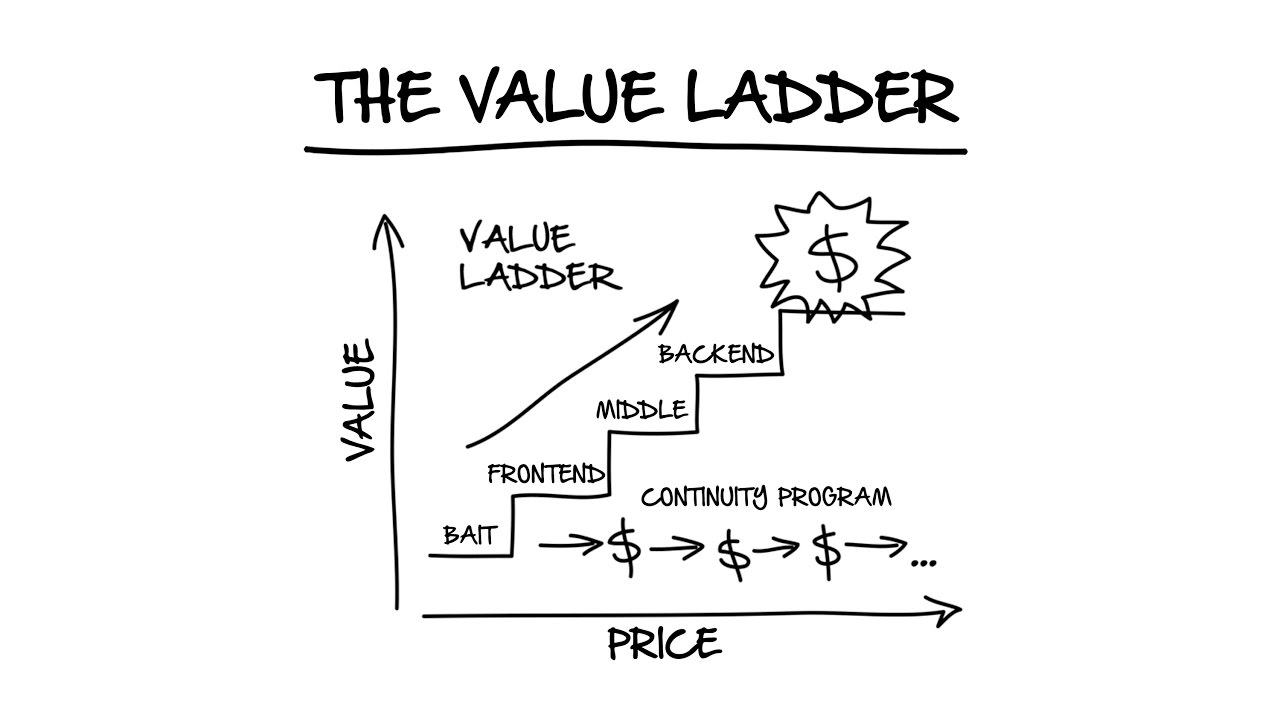
Source: DotCom Secrets Book
The first step in your Value Ladder is the Bait, as in the thing that causes them to pause and click on the link to your website. For example, our Yelp page reviews are a bait. If you do ads, those are baits. A bait is your content appearing on other platforms, hooking your prospects in by being intriguing, and then reeling them onto your website.

Bait to hook people and then reel them into Coach Viva’s Frontend
Once they are reeled onto your website, they proceed through the pre-frame bridge and then to the second step in your Value Ladder, called your Frontend. This is collectively Steps 3, 4 and 5 of the 7 steps, which happen in the same session, so you catch all the people who’re ready to buy.
3. Offer your prospect something of high-value (example: an e-guide on how to break weight loss plateaus) in exchange for their email / some way to connect with them without algorithms you don’t control getting in the way. The goal is to, at worst, have a way to continue building a relationship with them, and then point them to step 4 again if they didn’t buy the first time around.
4. Offer your prospect something of high value for cheap that builds upon your offer in Step 3 (example: a comprehensive book on how to DIY fitness for $5). The goal is to test the waters to see if this prospect is already bought into your worldview and ready to buy right now.
5. Offer your prospect something that's more expensive and makes your offer in step 4 faster, better, stronger (example: a personalized nutrition and exercise plan for $50 so they don’t have to spend time translating the book to actions in their life). You’re targeting buyers in heat - for example, I was one when I went to Amazon to buy one book to learn design, and ended up buying 3 design books because they all looked so helpful.
You can collapse steps 3 and 4 into one step (example: by selling a physical product that’s free as long as prospect covers shipping cost) or skip step 5 altogether at the beginning. Step 4 could also be someone else’s product with whom you split revenue.
There is a lot of flexibility in how you implement these steps as long as you satisfy the two goals of the Frontend:
A. Create offers that make your CAC = < Revenue from your Frontend.
B. Your Frontend converts your prospects’ beliefs into your worldview.
Let’s dive into A first as that’s the lynchpin of how you can grow fast without VC funding.
For the sake of easy CAC calculation, let’s say you’re using ads as the bait to drive traffic to your Frontend. We’ll assume that the ads are costing you $1.40 per click, which means it costs you $1,400 to drive 1000 prospects to your Frontend.
Now let’s say 38% of the prospects gave you their email in Step 3, which means you got 380 subscribers. Next, either when you showed Step 4 after Step 3 or through your relationship building sequence of communications leading them back to Step 4, 9% of subscribers bought your $37 product. Your total sale is $37 x 34 = $1258.
After that, let’s say 7% of your buyers also purchase your $197 offer in Step 5, which brings your total sale to $1,258 + (3 x $197) = $1,849. This equates to $1.85 earnings/click which is greater than your cost of $1.40/click. You have a winning campaign where you’re making a profit!
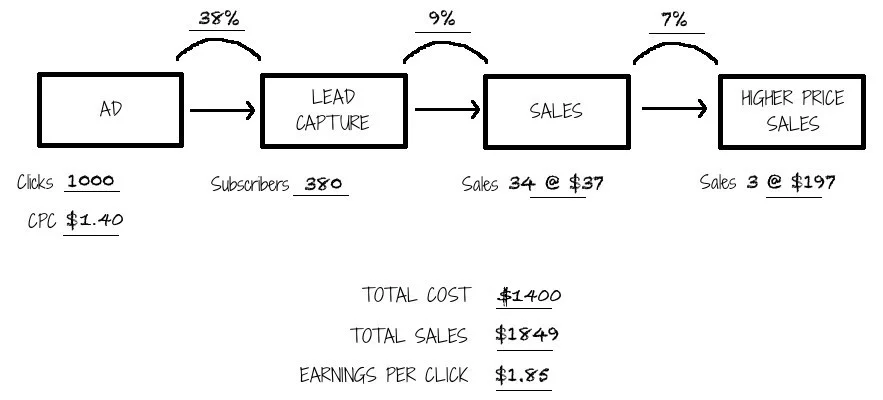
Source: Fill Your Funnel Secrets Book
Let me repeat the two important points from this example:
If you were only selling your first offer of $37, you’d be making a loss ($1.26 earning/click vs. $1.40 cost/click). It is the sequence of offers building on each other which helps you beat your ad costs. If you’ve read any negotiation book, you know that once you get the first Yes, it’s far easier to get subsequent Yes’ on bigger and bigger asks.
You’re getting paid to acquire customers. You can literally outspend anyone to get customers. You see now how you can grow fast without VC money?
Now let’s talk about goal B (your Frontend converts your prospects’ beliefs into your worldview) which compounds your growth and profits created by goal A.
The actual offers you make in your Frontend must make your customers your huge fans. This means two things:
They cannot believe how much value you delivered for how little you charged them.
The value you gave educates them thoroughly into believing your worldview.
That last bullet is especially important when we get to Step 6, where you multiply your Frontend profits while having $0 CAC.
Step 6: Age & Ascend the Relationship
At the end of your Frontend, you have a customer, that is, someone who has already bought from you and helped you acquire other customers at profit.
At this point you pause on the sales and nurture your relationship with them by sending them high-value emails / whatever direct communication channel you choose to deliver them entertainment + value. You tell them stories about yourself, share what you’ve learned, what you’re doing, your failures and successes, and essentially get them to know you better.
Once you feel they’ve been nurtured well, you now ascend them to the Middle of your Value Ladder. This is the natural next thing they need in order to make use of your Frontend.
For example, Coach Viva’s Frontend are courses which teach people the science and DIY methods of how to lose weight. A natural next thing they need are the tools which make implementing said methods easy and quick.
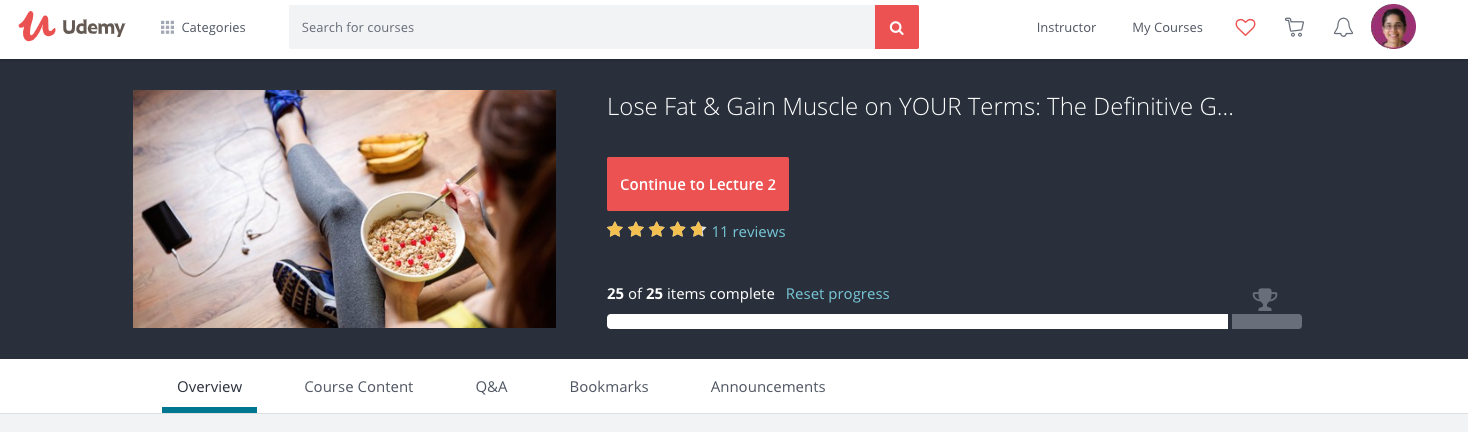
Frontend course of Coach Viva
If your Frontend did a good job of converting their beliefs into your worldview, these customers will be primed for your Middle Value Ladder, and guess what, selling it to them costs you $0! It’s pure profit from here on out as you age and ascend your customers up your Value Ladder.
Your Middle Value Ladder could be one offer or many. For example, at Coach Viva, our tools are our first Middle offer while coaching is our second Middle offer.

Frontend course nudges students to review what they learned by taking a quiz hosted by Coach Viva, which then seamlessly leads into offering the Coaching Middle offer
At least one of your Middle offers must have a continuity revenue model, that is, be a recurring source of revenue. For Coach Viva, we plan to have both Coaching and Tools have a continuity revenue model.
Also, remember the mindset shifts we talked about: this could be not just software, but a membership site or information product subscriptions like magazines.
Step 7: Change the Selling Environment
Throughout Step 6 you’re nurturing your audience with email / other communication methods, and at some point those who bought your Middle offer(s) will be ready for your Backend offer. This is generally a high-ticket offer in the 4+ figure range, which is why you need to change the selling environment into a phone call or some such 1:1 communication to make the sale.
Just like there can be multiple Middle offers, there can also be multiple Backend offers. These are generally offers where you are "physically present,” like a consultation or retreat or mastermind. In fact, as you gain fans, you could start putting together virtual or in-person Backend offers, and see who bites. You don't have to wait until your Frontend and Middle is profitable before experimenting with this.
Last note
It's okay for prospects to jump directly into Middle or Backend if they are ready. Not everyone needs to go through the Bait to Backend in sequence.
However, it’s interesting to note that both Russell Brunson on his podcast and Rand Fishkin of Moz in his book have remarked how the customers who go through the education journey from Bait to Backend tend to be on average the highest LTV customers.
Where we are at with Coach VIva
We are still in the process of figuring out our Frontend that meets the two A and B goals mentioned above as well as setting up our public presence, that is, the Cold traffic sources.
One of our frustrations with 2018 was we set goals that aren't directly in our control, like revenue or customers.
In 2019, we have set a goal to do 100 needle moving experiments (50 by me, 50 by Lucy). All must be “skateboards” in Spotify MVP language, and they must target whatever happens to be our bottleneck in the 7 step customer journey at the time of the experiment. As a byproduct of this consistency, we hope to see the out-of-our-direct-control goals move in the right direction.

A gift for you
When we first started, ironically despite being a health business, both Lucy and I stopped exercising, sleeping or eating right.
In the past 6 months, we have reversed a lot of our slips as they were causing noticeable drops in our energy levels and mind clarity.
We know that you, like us, are super busy running your business, and don’t always have time to do the prep work (meal planning, workout program creation, building systems for self-accountability) that’s required to upkeep your health and fitness.
That’s why we’ve created a short quiz that asks you 3 quick questions to first understand, then offer the kind of help you need most right now to make keeping your health and fitness up easier.
That’s it from me for now. I hope this has gotten your brain whirling with possibilities. I’d love to hear your thoughts! You can reach me here.