
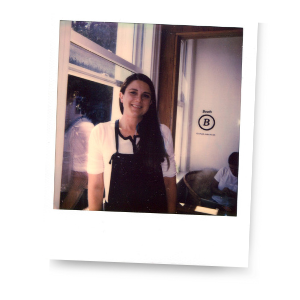
Molly Goodson: The Go-to-Market Genius
Meet Molly Goodson, CEO of The Assembly, a two time start-up founder and former VP of Content who’s masterfully leveraging her background to build a better women’s clubhouse.

Molly Goodson, CEO and Co-Founder of The Assembly in San Franscisco
Ms. Goodson on...
Her untraditional path to an $800,000 seed round
Leveraging network effects for a successful go-to-market launch
The design trade-offs that create a more human experience
How to staff a team to run a thriving hospitality brand
The importance of brand guidelines to inspire your team's best work
This conversation took place on April 12, 2019 at The Assembly in San Francisco’s Mission District. It has been edited for brevity and clarity.
Underwire: Tell me about your journey to The Assembly. You came out of content world as the VP of Content at POPSUGAR and then co-founded a startup called Spright.
I left my job at POPSUGAR at the end of 2014 and I didn't know what I wanted to do, but I knew that I needed a break from the constant content creation world that we live in. I was helping to manage a team of 70 women creating 500 pieces of content a day. The world had changed a lot from 2007 when I started there and 2004 when I started writing online and I didn't quite realize how burnt out I was.
I really wanted to think about health and wellness because what I saw was that women, especially those who are leaders in all things, were really seeking different ways of being talked to about their own self care, health, and wellness. They were thinking about it differently, and that the way that they were being messaged to wasn't really keeping up with the reality.
I knew that there was something there, but I didn't know what it was. At that time I had been approached by two guys, one of whom I'd sort of known and one of whom I was a complete stranger to. And they were like, "Hey, we're fundraising for a health and wellness content startup. We know we need a content person. Do you want to come be our third co-founder?"
The two other co-founders had started down a fundraising path already. They both were well connected to the fundraising world and had a main investor lined up. They just needed the last puzzle, which was me. So my first experience with fundraising was coming along to meetings and answering a couple questions about content strategy and how to think about it, but the legwork had already been done.
Was that for a seed round?
Yes. I was brought in fairly late in the process. I knew going in that I was getting much less equity than they were.
For two years, myself and the co-founders, along with a small team, we built a health and wellness app called Spright. It was in the app store. It was like The Assembly in app form. It was small group conversations. It was trying to make coaching and other sorts of health and wellness type things accessible to groups.
Eventually we decided to wind that down. And we made the decision to shut that down at noon on election day in 2016 when the world felt a little different than it did even that evening.
So we went back to the investors and said, "We still have some money in the bank, but we just don't think...this is not the thing. We'd like to let the team go, give them severance and then there's still some money in the bank which we can give back to you."
And they said, "How about you do the first two things, let the team go, give the severance, and then go take a break. Go walk around for a couple weeks. Think about this, and if you feel like you guys have another thing in you, together, and you want to do it, come back to me and pitch it, and we can talk out it. And if not, sure, let's call it.”
So it was right after the presidential election, and I spent about six weeks thinking this is a wake-up call for a lot of people in this country, myself included, and it coincides with me reckoning what felt like a huge failure. And it was, Spright was a failure. I thought, what does that mean for myself? What does that mean for me as leader? And what does that mean for me as an entrepreneur?
When I was wandering around, I was seeing that there’s a whole world of women moving throughout this city just trying to figure out where they're supposed to be going in the middle of the day.
Women are at coffee shops. I would talk to women who would sit outside their own homes in their cars for hours on end because the kid's inside with the nanny and she can't go inside because the moment she goes inside she can't get any work done. Or there are women who would rent motel rooms for the day just for themselves to have one business call.
I would ask, “Why wouldn't you join a coworking space?” They're like, "That's not for me. I don't need that. I'm a designer, I just have a couple interior design clients. I don't need a space, but I do need a place to get some work done."
And I realized, whatever narrative's existing is not talking to these women, myself included. I went to WeWork, I was like, this is not for me.
And the places where people felt really happy, the yoga studio or Soul Cycle, but those business models are not made for you to stay and hang out there afterwards. They're like a revenue per square foot, butt on bikes kind of thing, like how many people can we cycle through this place within one day?
And so I started thinking, is there a business I could do that brings these things together? Can I do it in a way that feels really good, that's nonjudgmental, that is all the things I dream that a health and wellness space could be, and have a business model that appeals to the woman who just needs a place to go and get stuff done for a couple hours?
So, I went to my co-founder from Spright and said, "I think this is it. I have this vision for this thing and this place." He said, " If you feel that way so strongly you know this better than anybody. You're the customer and you know how to market to women. You know how to do this. Let's do it."
So we went back to the investor and told him we wanted to open a physical building. He said, "That's outside of our purview but you can use this money to get yourself started. We're going to drop our shares to common shares so that you can fundraise more easily in the future. We're not coming in again. We're not giving you more money, but we'll maintain a small ownership in this, and you can use the money for your new thing."
Who was that original investor?
Gus Tai, from Trinity Ventures, which is a big VC firm.
So we used that money to sign a commercial lease. We had no background in commercial leases. We are not people that landlords want to sign a commercial lease. And as far as the landlord to this building saw, he's like, "I see you yahoos over here who have never opened a physical space before, and you're coming off of a failed business. Why would I ever rent this place to you?"
So with the money that we had from Trinity, we paid for a whole year of rent up front.
I bet that was scary.
That was the largest check I've ever written in my life by far.
We signed a three year lease. We paid for a year and he gave us 14 months for the cost of 12. And then all of a sudden we had this building. And it was July of 2017 and we had no money to do the rest.
At the time, the deal that my co-founder, Carnet Williams, and I made was that our partners, my husband and his wife, supported us enough over the past two years and we didn’t want to put in our own money. So we decided to go out and try to raise money elsewhere.
Over the next eight months we raised another $800,000 on the same terms, because technically it's the same entity that we raised for in 2015.
Is that unique? The situation with Trinity letting you keep the money sounds rare.
It is unique. Which is why I told the whole backstory about fundraising. Thankfully the things that Trinity did made it easier for us. Although most companies, when they're at our stage, are doing price rounds.
So, we raised $800,00. That was a mix of one really lovely, supportive micro VC, Charles Hudson, who’s firm is Precursor, and then a lot of hustling from angels. It was me out trying to pitch this dream, to get into an angel community. I was not hyper connected, even though I've been here in San Francisco for a long time.
Pitching to angels
What did you learn about pitching to angels?
I know this is controversial to say... and I completely understand why it is... but when I was going out first pitching to angels, and more seasoned investors, I was told by many people that you're going to have a harder time with women than with men. And I have seen that to be true.
For women I think they're so worried about the standard that they're even being held to that I think that they are, in some ways, more risk averse than men. I've met women who don't want to do consumer stocks because they don't want to be seen as, all women do consumer only, and who just want to stick to really tight guidelines of what they invest in.
Since we've been open that's shifted a little bit. We actually have a probably 10 or 11 members who've become angel investors just because they love what they have here and they believe in it. I think they're inspired by seeing the other female entrepreneurs in this space and thinking about us breaking down the barriers of what you need to do to be an angel investor. You don't need to be anything to invest. You can just be someone who is passionate about an entrepreneur that you meet.
We have work to do on supporting each other, especially when asking another woman for money. What have you noticed about the female-to-female dynamic?
There was one meeting in particular, and, again, I still am very new at this. I still work on my own confidence in these conversations, work on my own abilities to say with a straight face, "This is a billion-dollar company." That's hard for me. At a point about a year ago in an investor meeting, when a question came up about the financials, I let my male co-founder answer. I'm the CEO and I know the answers as well as he does, I sometimes defer to him in those things. Because in our dynamic, yes, he is the one who is sort of managing the financial model. Not that I don't know it in and out, but, you know, that is something that he's doing.
And I got a call from that investor who was like, "I was going to invest in you, but you deferred to your male co-founder on all the financial questions." And she walked.
How did that make you feel?
It made me feel terrible. It reinforced my insecurities in a lot of ways. It made me feel like both, yes, that's a great learning moment, I should be better about that. Since then I've made a point to not bring my co-founder along to a lot of my initial meetings. Not because we don't have a great relationship but because I need to not have a crutch. And as a first time CEO I need to be able to answer those questions. And I can, and I could then too, I just didn't in that moment.
It taught me a lesson about how fragile any of these things are and also that you have to be able to move on. You can't dwell on that stuff. It stung and it was painful, and it's someone who I still have a relationship with.
Why do we feel that imposter syndrome?
It just is so hard to verbalize that billion-dollar thing because I'm so practical and real. I've got a real business that is working and makes, and yet, just getting the words out of my mouth is impossible. I don't know if guys are just conditioned to be slightly better bullshitters or they just don’t worry as much about those things. We'll go into meetings together and he'll be like, "Come on, let's get amped up. It's going to be amazing." And I'm always over here having an anxiety attack.
Because you’re attuned to the practical side of things…
Yeah, totally. And knowing full well that I am running a healthy business. It’s still, to this day, a real challenge to do that sort of big picture thing. Even though I see it and I want it and I can tell you the pieces of it, but still.
Did you open The Assembly while you were still raising?
No, we closed that round before we opened because we felt this place would have more value as soon as we opened, so let's at least give investors some advantage to having gotten in early. We closed the round in the very early days of January 2018 and we opened two weeks after that.
Go-to-market strategy
That is an interesting segue into your launch. The Assembly is a thoughtful, carefully designed place to work, exercise, connect, heal or just hang out. Like the best ever women’s clubhouse. You’ve done a phenomenal job of marketing this business. Did you have a clear plan of attack for your go-to-market strategy?
Thank you. Yeah, I knew that our launch plan was centered around two main pieces.
One was the fitness, health, and wellness part of it. I think that instructors and teachers are incredibly valuable, and even if they don't have giant “followings,” they have an incredibly loyal local group of people.
That was a strategy that no one else was looking at. So I knew if we had strong classes being taught by strong teachers it would bring people to the building. When people come into the building, they will want to stay in the building. That I know.
And then similarly with the artists, the second piece is that we chose to work with women to create artwork for the space, and they in turn shared along the way.
Having it centered around the wellness and the space, that was my strategy to create early buzz, not leading with the co-working.
That is wicked smart to get contributors to share out organically. That’s the benefit of having a content and brand marketing background.
A lot of our earliest press led with coworking because people are going to lead with whatever framework is trendy or feels like it's on point, but I wanted to be sure those other messages were getting out there.
In our social media presence, we knew that Instagram was going to be our main lever from the beginning. We made sure the images were an equal division of community people, beautiful space design, and movement. The design here definitely brings a lot of people to the door. And it’s important to see all sorts of bodies moving. We keep those three drum beats going.
I also knew there was going to be a newsletter that came from me that was going to have my own voice and vulnerability to it. It is very real and personable and relatable. That is something that has resonated a lot with folks. It's increasingly challenging to get myself to write it, but as, you know, newsletters…
Content marketing
All too well, that makes me ache, it's so time-consuming to do a newsletter. Way more than you think it will be. You have to carve out big chunks of time to write.
Yeah, exactly. But that was a big piece of it. And just thinking of the programming or every event we have here, that's the storytelling part of it, not me out there telling people what we are. Because we are not what we say we are, we're what people experience when they come in here and go out and tell other people. Your brand is not what you say it is, it is what other people say it is.
So how do we take a month of programming and think of it a magazine? What is your cover story? What is your editor's letter? What are the different pieces of it that tie in?
Some of them are recurring features that you have every month. You have this, this, and this, and then there's the other exciting things that you put in. So coming at it from that mindset is also different.
I've been in a lot of coworking spaces and hearing your background and how you're treating it like a magazine is really fascinating. I think that's a lesson that a lot of women could use. Even if a tech company were to think about their marketing in that way.
I talk to a lot of women who open coworking spaces and the work part is fantastic but it more of a byproduct for me. I love that people are building their businesses here, or just working here, or having meetings and all of that stuff. But the actual product is really the design, the feelings, and the experiences of The Assembly.

The entrance to the The Assembly's main room, with original stained glass.
Investment in design
Hallelujah! We human crave structure, utility and beauty, the essence of good design. I’m so glad you created this and think of the experience in this way. I wish more startups would invest in design. What trade-offs did you have to make, because I know it's not cheap to create a space like this?
We did a lot of it ourselves. The trade-offs that we made, primarily, were we did not try to cram as many seats in here as humanly possible to get as much money out of people as humanly possible. I think most spaces that are work centric, their goal is to get as many people working in there as possible.
It’s hard now that the space is full, until we get our second space open, that people come in and they wonder, "Why don't you just put more tables in the middle of this room?” Well, we're not going to put more tables in the room. That's been a struggle in trying to get people to understand and it's definitely a trade-off.
It also is a delicate space. Stuff breaks. People knock over the tiny cactus plants every single day. One of our big, very well-funded competitors, well, all the plants in their space are fake.
I get it. When your business is churning these things out as quickly as possible to get an Instagram worthy vibe, but not have to staff up as much, right? I mean, that's my assumption.
It's a pain in the ass to have literally hundreds of living plants in this place, but I believe that being around living plants is incredibly important and makes people feel healthier. You breathe easier and you feel lighter, and you know, no one else has to take care of them. You don't have to have as many plants in your home. We'll have all the plants here and you can spend time with them.
You were building out the space before you closed your seed round. How did you pay for it?
We had a lot of money on credit cards.
That's how we do it. We juggle. And hold our breath.
Juggling, yeah. A lot of money on credit cards, we deferred some payments on those. Definitely by the skin of our teeth.
Thankfully we had a design team that knew how to make things look nice even if they're not expensive things. The main area is a mixture of things from World Market and others completely made by women artisans in San Francisco. It's a real mixture of things.

The Assembly's main hall. The bar on right was designed and built by a female artist.
Team structure
This is a vibrant, busy space. There's a full schedule of classes in the downstairs studio. There's a kitchen with helpers. There's an outdoor patio. There's the main space. And I know you do a ton of events. With so much going on, how is your team organized?
Realistically, we are running three different business here in a pretty robust way. We have a fully running fitness studio, we've got a coworking space, and then we have an event business. So it takes a lot of bodies.
We think a ton about hospitality. When we originally made our financial model, we had some assumptions about how much staff we would need in the space, and we definitely have way more people than we thought we would.
Team structure is probably my biggest day-to-day thought exercise. We've experimented with a couple different things over the past year to figure out what's right, and what both sets us up for growth but is also reasonable for us at the current time. We’re running a seven day a week, twelve hour a day operation, and we put on thousands of events last year, literally almost two thousand, including our classes.
So for the operations of the building, we have a general manager who sits at the top. Below her there are four assistant managers, and then there's hourly staff. That team manages everything that happens in the building. That's scheduling the maintenance guy, making sure it's set up for events, all the different pieces of it. Getting the studio ready between classes. We have a cleaning service that comes at night that for day-to-day maintenance of the space.
That's the team that's probably way bigger than we thought it was going to be. They also give tours. They’re also close to the members. So they also do the selling, basically.
That is a switch that we made halfway through since those are the folks that are having the most front-line interaction. If we arm them with the information to give all the tours and take people who are walking in off the street and all that stuff, they can they be the ones to take it all the way over the finish line. That's the operational side of things.
On the other side of, I've got myself and my-founder, so technically there's really the CEO, COO, and we have a woman who's our chief people officer. She does all the HR kinds of things. She comes from that background but also membership. Like health of the membership. What does attrition look like? What are people saying? What's going on?
Then we have a programming team. There are a couple women who are programming. One is more centered on fitness, one is more centered on the health and wellness side of things, and one is more focused on anything that comes in that feels like a partnership.
And there's another person who focuses on food and beverage in events or in the kitchen, the snacks, and then any sort of like catering that needs to happen for events. We bring in a ton of food for different things. And also event execution.
We also have one engineer, because we built our entire digital system ourselves. So our booking, our member portal, the sign in you signed in when you came in here, that was all built in house. And we have a product manager who's in Seattle and works remotely.
What about marketing?
We have one woman who just came back from maternity leave who is content with me. She and I worked together in the past. So that's, what is our social voice? What is our newsletter voice? What do the signs say in the building?
We don't have anyone who's squarely on marketing, which is definitely a hole in our business. In the beginning I was thinking I can handle some of this. It's something that as we think about the future, it's definitely about who is the right hire? Is it somebody who is really growth-marketing centric? Is it somebody who's more on the creative side? I'm still figuring that out.
The importance of brand guidelines
And you’re setting the vision and the voice?
Yes. We've got a pretty intense style guide. Like everything, the more guardrails you put up the more that frees people to play in the middle, and the power people feel when they know they're not going to mess it up because they're all staying within guidelines. I tell that to people a lot.
I learned that from my content days. If you give people a lot of freedom and then you constantly tell them that they're doing it wrong, it's a really messed up dynamic. Because yes, I have a very clear and precise editorial vision, and it only is detrimental to everyone if I don't express it as much as I possibly can. In a kind and encouraging way of course, but people want the guidelines.
That explains why The Assembly’s brand it so solid from the physical to digital to intangibles. I'm a brand marketer and I preach the power of brand guidelines. That is a discipline I wish more startup founders would embrace.
Totally. You know, we had a guy who sort of helped us build our website and do some initial branding concept where he made the logo for us and things like that, but we didn't go hire some big branding agency.
You don't need it early stage IF you come from a background like yours. Look at what you've created with just your vision and expertise in content.
Yeah. Sometimes I feel like when I'm listening to other people's stories I'm like, “Oh is that the way to make anything work? You just hire some big branding agency?”
I used to run a branding agency. Even when we would work with startups we would try to find a way to do it bare bones, but to shape the bigger vision of the brand. It’s often hard for founders to link their vision to a higher order purpose, like you have with the emphasis on hospitality. For instance, when I walked in, a lovely woman made me feel welcome by asking in a genuine way about how my day was going. She asked an open-ended question. She embodied The Assembly brand.
And fortunately we have enough people to do that. We prioritize that. It's in the way that we train, it's having enough people so that someone can walk around and literally touch tables and say, "Hey, do you need a refill?" or whatever it is, to have that feeling of being taken care of.
It's not a luxury country club, but what we've seen is that when the folks here, members or nonmembers or visitors, when they feel like they have that little bit of humanity from us, they treat the space with human dignity. People put their own dishes in the dishwasher. They don't leave stuff on tables. They do treat it nicely because they are free to, like you're walking into someone's home.
Solidifying our brand of hospitality has been our biggest secret advantage. We don't have a front desk of a woman just sitting on her phone just checking you in. But there's the ask, "How are you?” or "How's your kid?"
I also think that the way you're pulling people into the space from downstairs is revelatory. Frank Lloyd Wright believed that you use architecture to evoke feeling. His spaces were notorious for compression and decompression. Upon entry, he used low ceilings to compress the breathing and help you transition from the outside. Then he’d lead you into a high-ceiled living space that’s open and light for an emotional expansion. You have that going on downstairs at The Assembly. It's a little bit dark, but a lovely neon sign pulls the eyes up, then you wind up the stairs and the space expands. I felt my neck and shoulders release when I walked into the main hall.

The entryway to The Assembly with custom neon design by a local female artist.
Yeah, you know it's interesting. That was a definite design challenge when we came to the space. We knew that the upstairs was going to be that focal point, that magical moment, but we thought, okay how to we get someone in off the street? There's no place for a desk down there, no one's getting checked in downstairs. They're alone, right? Like, you're alone for a minute there, and you're going to ring a doorbell.
It's a building that you're confused by when you walk in and you walked by it a million times and you've never noticed it and it doesn't have a big sign out front, and so just that experience of sort of like, okay, when they walk in and they're alone for a second, how do we make that a calming moment and not an anxious moment? And how do we gently guide them upstairs, and have them figure out what to do?
And if you choose to linger or pause, you notice little details. That attention to detail often gets skipped in a startup budget.
There are little affirmations written in secret places downstairs too, if you look close enough.

Our convo ends with the first thing you see at the entry to The Assembly.
Visit The Assembly’s website to learn more about this unique place.

Techstars Accelerator
Learn more about Techstars Accelerator program and meet two female-identifying CEOs from the 2019 Seattle program.
One way to take your company to the next level of development is to join a startup accelerator. These organizations, with mentor networks and financial contributions, help young companies leverage initial successes, fine tune business models, and demo their products for potential investors.
If you’re considering an accelerator, here’s a helpful tool for understanding your options:
Seed Accelerator Rankings Project
Also known as SARP, this group is led by researchers from Rice University, the MIT Innovation Initiative Lab for Innovation Science and the University of Richmond. They track quantitative and qualitative factors like startup outcomes and founder interviews with the intent to encourage research about the seed accelerator phenomenon, its effects, and its prospects for the future.
Encouragingly, SARP is led by two women—Yael Hochberg and Susan Cohen.
One of the top accelerators on SARP’s list is Techstars. Samantha Bell from the Techstars Seattle team wrote the article below, and conducted a short Q&A with two female founders in the 2019 Techstars Seattle class— Surbhi Rathore of rammer.ai and M.H. Lines of Automaton.
Read about their Techstars experiences here:
Techstars Seattle x Underwire
Comprehensive support. Investor access. Accelerated knowledge. These are the three main reasons why startups choose to exchange 6% equity of their company (issued as common stock) for $20,000 when joining a Techstars accelerator. Upon acceptance, every company is offered a $100,000 convertible note.
To date, out of the 3,315 individuals who have gone through a Techstars Accelerator and self-selected their gender as male or female, 477 of those individuals, or 14%, identified their gender as female.
Though today’s startup ecosystem is predominantly male, research shows that companies with female founders often outperform their male peers. Through its network of hundreds of companies and startup programs worldwide, Techstars hopes to influence this on a large scale.
In 2015, Techstars launched the Techstars Foundation, a non-profit created to improve opportunities for women and underrepresented minorities in tech. So far the foundation has supported 15 non-profit organizations and hundreds of underrepresented entrepreneurs.
Roots of Techstars accelerator programs
Techstars is the worldwide network that helps entrepreneurs succeed. Since its founding in Boulder, Colorado in 2006, Techstars has expanded to 150+ countries with 10,000+ mentors in its network. To date, Techstars has invested in 1,700+ companies and has raised nearly $7 billion in funding. With the addition of the Techstars Starburst Space Accelerator, Techstars now has 46 accelerators to consider when applying.
Do more faster: In 3 months
Techstars helps startups do more faster, every day, by surrounding them with people who will mentor, inspire, and challenge them. Within the first month of the three-month accelerator, startups begin growing their network during Mentor Madness week. From these hundreds of interactions, companies select three to five lead mentors who help with product development, market fit, and provide valuable introductions.
In addition to working with their lead mentors, startups work with the Techstars Managing Directors to hit their milestones and gain traction. Over the course of the program, startups will determine their fundraising strategy and prepare to meet with investors, allowing them to accelerate their business.
So what does all this hard work lead to? At the end of the program, companies can show how much progress they made at a culminating demo day. The startups spend the last month of the program crafting and perfecting their five-minute pitch to investors, family and friends to present at this celebration.
Techstars doesn’t stop once the program ends. Companies can leverage the network post program through events and access to a deep well of resources for life.
Want to submit your startup to Techstars?
Application periods vary for Techstars’ different accelerator programs. Information around what programs are accepting applications, and when, can be found on the Techstars website.
After applications close, each program spends about seven weeks getting to know more about the applicants’ ideas, teams, and market progress. The final group of companies accepted into each accelerator is typically notified within eight weeks from the application closing date.
Make sure you pick a program in a location that will give you the best opportunity to build the right network with the right mentors. Who knows - you may end up relocating your company there once the program ends!
For a full list of programs, click here.
For tips from Techstars’ Managing Directors, click here.
Preview application questions here.
Techstars Seattle Accelerator
Techstars launched Techstars Seattle Accelerator in 2010 with ten companies, five of which went on to be acquired. Of the Techstars top 50 companies, six went through the Seattle Accelerator, including Zipline, Outreach, Remitly, Leanplum, Realty Mogul, and Skilljar, with the latter two having women CEOs.
Combined, Techstars Seattle Accelerator alumni have raised nearly $900 million, and now employ thousands of people in the Pacific Northwest and around the world.
The Techstars Seattle Accelerator receives hundreds of applications based on the opportunity to build the right network with the right mentors, and female founders are highly encouraged to apply. There have been 29 founders who identified their gender as female that have come out of Techstars Seattle.

Techstars x Underwire: Surbhi Rathore
Meet Surbhi Rathore. She’s using AI to connect conversations with better business outcomes.
Surbhi Rathore is the CEO and Co-Founder of Rammer.ai, a technology company focused on conversational AI and business outcomes. Surbhi was a participant in the 2019 Techstars Seattle class.
This Q&A was conducted with the help of Samantha Bell from the Techstars Seattle team and has been edited for brevity.

Surbhi Rathore, CEO and Co-Founder of Rammer.ai and 2019 Techstars Seattle participant
In what ways did the program differ from your expectations? What did you have to change and adapt to get through this?
The Techstars program is a milestone in my journey as a founder. I knew that the program would help us fill in the gaps, but it has been so much more than that. In the past two months it feels like we’ve built our own founder/mentor family who are, and will, continue to support us beyond the program.
We have a team in India, so I was overseeing a lot of decisions until now. With the schedule of the program, I am taking a step back on day-to-day activities, and I think that has really helped everyone on the team step up and own the territory of their roles.
What have been your top 3 highlights of Techstars Seattle?
The Techstars network effect is phenomenal. We’ve been able to access a network of mentors, alumni, investors, customers, and partners that would have been extremely difficult to access outside of the program. This has helped accelerate our company faster than we could do on our own.
I always look forward to “Mentor Thursdays,” where we spend the whole day with our lead mentors.
Connecting with the other startups and the Techstars staff. I always look forward to “Highs and Lows” on Fridays. It’s where we literally talk about anything and everything from the week over drinks and snacks. I also loved the Founders Retreat, where we spent three days in a remote location focusing on leadership workshops and connecting with our peers.
What experiences have you seen that set female founders or CEOs apart from their male counterparts?
I think women look at work differently than men. In addition to being great at understanding and handling finances, we connect with the customers and our team on a different level. Not that male founders don't, but I have seen this connection in a lot of female founders throughout my journey so far.
What gets you excited about the start-up scene around Seattle?
We are headquartered in San Jose, so we’ve experienced the startup scene in the Bay Area. Seattle has been amazing. The people here, especially Techstars alumni and mentors, have a give-first attitude towards the new community that I love. It’s great to feel like we are a part of this big startup family here in Seattle.
Why did you apply for this particular accelerator program?
Seattle is the center of technology, and there are super successful companies that have come out of here, especially in the space we operate in—AI in conversations.
Plus, after talking to Chris Devore and Aviel Ginzburg, the program's Managing Directors, we were convinced the Techstars Seattle Accelerator was where we wanted to be. Those two are amazing! They’re always around and have such deep insight into what we do. Working with them has been just phenomenal.
Thanks to the Techstars’ Diversity and Inclusion team for supporting this collaboration. Learn more about the Techstars program.
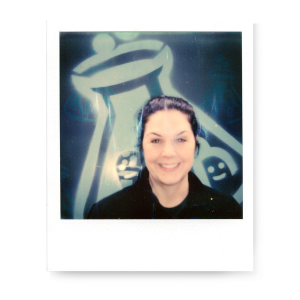
Techstars x Underwire: M.H. Lines
Meet M.H. Lines. She’s using dev ops tools to automate the sales and marketing stack.
M.H. Lines is the CEO of Automaton, a development ops platform for marketing technology. She was a participant in the 2019 Techstars Seattle class.
This Q&A was conducted with the help of Samantha Bell from the Techstars Seattle team and has been edited for brevity.

M.H. Lines, CEO of Automaton and 2019 Techstars Seattle participant
In what ways did the program differ from your expectations? What did you have to change and adapt to get through this?
Honestly, I didn't have many expectations. Of the programs I've really found value in, from getting my MBA to Women in Cloud, I've been able to really just let go and trust the program. That’s the same way I approached Techstars.
Throughout this program I learned that I can’t show if I’m having a bad day or even a bad moment, since it has a lasting negative implications on our business. I remember after one meeting feeling defeated and I whined to Aviel Ginzberg one of Techstars’ Managing Directors, “So I don’t get to have bad days anymore?” He responded, “No, you don’t.”
What have been your top 3 highlights of Techstars Seattle?
By far the people in the 2019 class. They're truly A-players. That kind of lovely and giving but hard-charging environment really gets you through.
The mentors. These are people I would never have access to before who have been critical in helping to figure out what we are doing.
The forcing function of a compact time period. Let's be honest, I'm running a venture backed startup, so the time crunch is my daily life, but having everyone exposed to it is helpful.
Any "oh crap, that didn't go how I expected" moments?
I didn’t take advantage of Chris Devore and Aviel Ginzberg, our Managing Directors, as much as I should have. I only saw them during structured hours, and they individually don't have as much of our backstory as other mentors or investors. Towards the end of program I worked to spend more time with them.
What experiences have you seen set female founders/CEOs apart from their male counterparts?
In this environment I don't think there is a major difference with the exception of women being better at multitasking, which is so critical for a startup and has positive and negative implications.
I think multitasking is a superpower of mine, more even than most women. I understand switching costs and when the rubber really hits the road, I give myself the gift of focus.
We are getting to a place where I can only focus on fundraising, marketing, sales, and general leadership and direction. I'm not saying that in an ironic way, either. I've got amazing, smart leaders who have taken other major things off my plate, and that list does feel focused.
There were a few male mentors who obviously had some unconscious bias issues (but surprisingly good intentions). With that exception, I'm just a person doing something exceptionally hard in the company of exceptionally smart, hardworking individuals.
What gets you excited about the start-up scene around Seattle?
Coming from the South/East Coast, I'm just really excited there is a startup scene here, and that it is as “buzz-y” as it is. The access to brilliant investors looking to write deals is amazing.
Why did you apply for this particular accelerator program?
Techstars Seattle, by global reputation, is a top accelerator. Being selected to participate alone was traction in and of itself.
I like that Techstars is a measured way to focus on what matters most and get super important work done rapidly.
You are married with three little ones at home. It must be hard to leave your family every morning. How are you able to take care of yourself over the course of such a demanding, fast-paced accelerator?
It’s easy to forget to take care of yourself in this environment. When I start to get tired, or things get really hard, all I want is to go cuddle up on the couch with my people. There are times I don’t feel like I have the luxury of doing anything other than simply pushing forward, both at work and in my private life.
My husband does more than any other father I've known—he participates, he cleans, he does laundry. He pays all our bills and sets up the college-savings accounts. But the mental work is still primarily mine. I book activities and camps, I get the Easter eggs, and I schedule the au pair and sitters.
On my desk sits a candle that reads, "Girl, you need to calm the f down." That pretty much sums up my life.
Thanks to the Techstars’ Diversity and Inclusion team for supporting this collaboration. Learn more about the Techstars program.
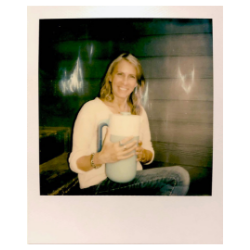
Nancie Weston: The Crowdsourcing Rainmaker
For Earth Day, meet Nancie Weston, CEO and Inventor of Raiin, two-time consumer hard goods starter-upper, bringer of fresh water to the masses and Kickstarter pro.

Nancie Weston, CEO, Founder and Inventor of Raiin
Ms. Weston on...
Building a consumer hard goods company, twice
The aha moment at a Goodwill store that sparked Raiin
The three things you need for a successful Kickstarter campaign
A side hustle that netted her over $20k last year
Underwire: Give me the quick spiel for Raiin.
Nancie Weston: Our first product is a water filtering purifier pitcher that takes out germs and toxins in seconds. With all the problems in the world, water shouldn’t be one of them. At Raiin, we design products which protect people and our environment.
Raiin is your second startup in the consumer products industry. How did you get started the first time around with Grayl?
I was working around water, always something to do with water—I worked with water filtration purification and waterproofing companies. In 2011, I had this idea about how to filter water a lot faster and easier than what's out there for the outdoor industry. I put together a business plan, rough sketches and started doing the research. Then I found a business partner. One of the reasons I wanted a business partner is because I had never done a startup and I didn't believe in myself. I really didn't believe that I could do it on my own, so now, eight years later, I've learned a ton and realize it's no problem to do it on my own.
It's actually easier without a partner. You don't have to argue, explain or teach someone. But as women we don't believe in ourselves, we don't believe we can do it on our own.
That said, I hired all male employees except one, and hired an all-male board. I wish I would have hired at least half to three-quarters female for the board and team.
I'm sure you didn't say, "I'm going to hire an all-male board." It happened organically?
It was organic in that investors who invest a lot of money won’t invest unless they get a board seat, and they happened to be male. We also needed experts in areas like finance. There are more men in those higher up positions than there are women.
Product Dev
While you were building the board and hiring employees at Grayl, you were also building the first product. How long did that take?
It took us 18 months to get to market with the first Grayl product.
And you got it into REI?
Yes. I had a sales background in the outdoor industry so it was easy for me to get into REI. They knew me, I had invented a firestarter in the category for them, and they were doing well with it.
What were other key milestones from Grayl?
Grayl won the Red Dot award, which is a prestigious award, one of the highest awards you can get for innovative products. We got the most innovative product award at the International Housewares Award, which is huge. They tend to give that award to large companies, and so to get the innovative product award was a big deal for a small startup like Grayl. We also got recognized as one of GeekWire’s top ten startups.
Origin of Raiin
How did Raiin come about?
While I was still at Grayl, our team was trying to figure out our next products. My business partner, the marketing team and my board really wanted to do a bottle which was bigger. My vision for that company was to bring the bottle to market and, if it was a success, invent a filter purifying pitcher to go in every home. Unlike a Brita, which only filters odor, flavor and some lead, our product would filter and purify germs and toxins, as well as odor and flavor. After introducing that product to the market, I then wanted to invent a product that would help developing counties, and millions of people around the world, to have clean water to drink.
But that's not what my business partner and my board wanted to do, so I said, "Alright you guys do that, keep doing what you're doing, I'm going to start a new company." I knew I wanted to do a water pitcher but I couldn't make it the same as Grayl. I didn't want to go up against my former company, and so I thought about it for a couple years. And then out of the blue I was walking through a Goodwill store, of all places, where I saw a drinking cup and thought, "That's it!"
I woke up the next morning, and I was like, "I know how I'm going to do it." That's literally how it happened. It's funny, people ask me, "Oh, so you're an engineer?" And I'm like, "No. My degree is in Parks and Recreation and Art." It’s fun to see the look on their faces when I tell them that.
Art school!
Yes. Grayl is one of those utilitarian products that’s also artistic and well-designed. That's why I won quite a few design awards.
The prototype for Raiin is beautiful. The lid, the handle, the soft body, it all feels thoughtful. I could see that product sitting on my countertop. It’s the kind of utilitarian product like my Alessi Lemon Squeezer that gives me joy to use it for a mundane task. Tell me about the design.
My whole thing is to make beautiful and functional products so I'm stringent on making sure that Raiin works, beautifully. It needs to pass drop tests. It has to pour beautifully. It should feel good in your hand. All of that is super important. The fun part is when I show it to people, they can’t keep their hands off it, they have to keep touching it.
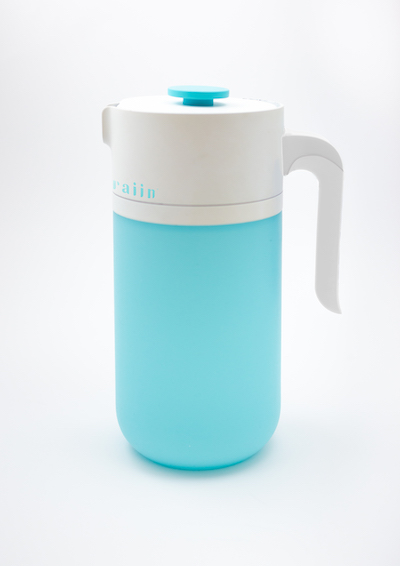
Raiin prototype
Fundraising...or not
What's fundraising been like for a consumer hard good?
I made a prototype and I took it to investors thinking that I already have a successful company under my belt, this should be a no-brainer for investors to invest. Wrong.
I pitched maybe 15 investors. I’d be in a room full of startups here in the Pacific Northwest and they'd all be apps or software, every single one of them. I did get in with one angel group, and I showed it and they said they don’t do consumer goods, they only do electronics. So I thought, “Now what am I going to do?"
One time, I was actually told by an investment group that I needed a male business partner for them to even consider me. It’s sad that we are still stuck as women and seen as less-than or weaker.
After trying to fundraise that way, I had to do a total shift very quickly because I was running out of money, which is really, really scary. I have one month left, I can pay my mortgage next month and that's it, and then I've got to either dump this whole idea and put it on hold and go get a job. I even tried to get a loan for my house and the bank said, "Well, you don't have a job." And I only have $30,000 left to pay on my house. I've got over $350,000 in equity on my house and they wouldn't give me a loan.
That’s when I thought about Kickstarter.
I ended up at Western Washington University talking to the entrepreneurship program. I said to a class of students, "All I need is a marketing and video person for Kickstarter." I had eight students come up to me after. One person shook my hand and said, "I've got 10 people for you on my team, I just started a business and I've got two video people for you, I've got a photographer, I've got a graphic arts, I've got a PR, I've got a social media, I've got a makeup person, lighting person, I've got someone to do your website." They had it covered, graphics, animation, they had everything. And he goes, "By the way, we'll do it for free because we need this on our resume. We need to show people we can do this."
It's divine intervention.
Yeah, exactly. I totally believe that. The universe throws me some walls, tough situations to make me really want it, but I definitely think that people cross your path for a reason and if you stay open you'll be lead down the right path.
(Here's the Raiin Kickstarter, which launched on Earth Day.)
Kickstarter Lessons
What have you learned about Kickstarter campaigns that might tip other founders to try crowdsourcing?
One, you have to have passion for what you are doing or it will never fly. There are so many times I wanted to give up but it was driving me crazy how many water filter pitchers are out there not telling the truth about what they filter out. If I didn’t have the passion for bringing clean water to the world, it would have been easy to give up.
I've actually done two other Kickstarters and an Indiegogo. So the second thing is that you've got to have a following. People don't just come to Kickstarter, you have to get people to go look at it, you have to be on social media months beforehand and you've got to be all over social media and develop an extensive email list.
Lastly, you need about 6 months worth of money to live on to do Kickstarter. Plus, you will need money to promote Kickstarter. For example, you need money to produce a video, run social media and advertising, and people to help you, etc.
What kind of following are we talking about to run a successful Kickstarter?
It’s all about your friends and family. They are the core of how your product will spread and they are the most passionate about helping you.
The press is also extremely important. Find your tribe who is passionate about your product or cause and they will shout you out to the world with enthusiasm. Your story about why you are doing your product is so important. People have got to trust you, so you need to get people to believe in you and the product so they'll buy it.
Is a sustainability message going to be part of your marketing?
Yes, definitely, I believe in sustainability. We will be made in the USA, I don't want all the carbon emissions that come from shipping products from China. Same with packaging, I don’t want any plastic on the packaging, I want it to be sustainable. Our filters are small and thin compared to the huge plastic filters of the competitors.
Self Care
How are you're taking care of yourself?
You know I try and be disciplined but….well, let's put it this way, since I don't have any money, it’s hard. I don't have a social life right now, so I'm not going out with friends. I'll invite them over for wine or cheese and crackers and things.
I jog every other day, and do yoga and yard work. It’s super important to stay fit, it keeps your mind clear, calm and gives it a break that keeps you from getting into any kind of anxiety or depression.
Also living in the present is a huge help. I work really hard at not thinking about the past or worrying about the future, but getting done what needs to get done right now, at this moment. Be thankful for what you have achieved so far, and the support you have at this moment from friends and family. I take walks to free my mind and just look at nature in the present moment.
I've got a 17-year old hot tub. And I like to cook and eat healthy. I like to hike, although I haven't taken a full day off to hike in a while. A day off…what's that?
Here’s something interesting…do you know what I'm doing for money?
Uh oh, what are you doing?
I rent out my home on Airbnb and I go stay at my best friend's parent’s house. I made a little over $20,000 this year doing that.
The things we do for our companies.
Yeah, really. I clean the house, pack up my stuff and go live at my friend's parents. It's humiliating at 55 years old, but hey. You've got to do what you've got to do to survive.
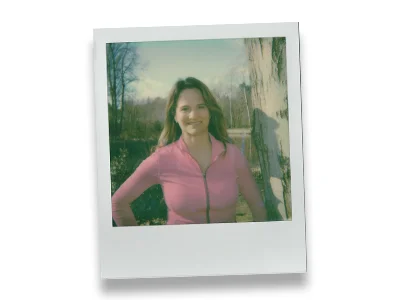
Michele Mehl: The Master of Startup Content Strategy
Michele Mehl, CEO and Founder of Excy, talks steady growth and instructs in how to use content strategy to sell, engage and get over yourself.
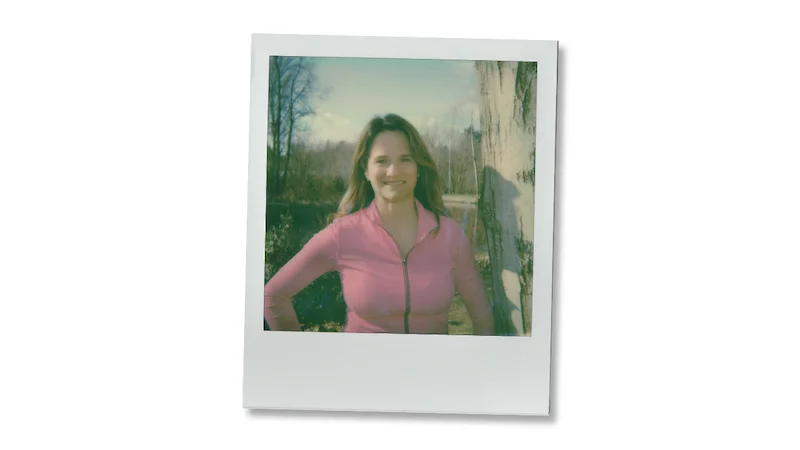
Michele Mehl, Founder and CEO of Excy
Ms. Mehl on...
Why she walked away from raising a million dollar seed round to focus on an intentional, steady growth trajectory
How to out-scrappy the competition and be more real with video—which led to nearly all Excy sales
Where to push content, and the tools to do it, to increase traffic, sales and brand loyalty
What 3 things help most for early-stage startup survival
Underwire: First off, tell us about Excy.
Michele Mehl: Excy is a multi-tasking portable exercise bike for anywhere cardio, strength training, and full body physical therapy cycling. We turn typical sedentary moments like watching TV, conference calls, reading a book, kid’s sport sidelines, and even time in bed, into opportunities to exercise.
Our customers tend to be active Baby Boomers and busy office workers with age-related injuries, disabilities, and health conditions, but also the rehab professionals who serve them.
Since the system folds for easy storage and transport and only weighs 14 pounds, it’s always ready when you are, wherever you go.
We also have a mobile coaching application with content for motivation, including videos from physical therapists.
Your videos are crazy inspiring, we’ll get to those later. Let’s start with what first attracted me to your story — the shift you made last year to an intentional growth strategy. You absolutely intend to grow a billion-dollar company, but it’s going to be on your terms. Go there. Please ;-)
For over 20 years, I have worked with or for venture-funded technology startups. I have seen the demands of raising capital. I’ve experienced the pace required to build a billion-dollar brand.
I’ve also been there as a friend and as a consultant in supporting entrepreneurs on their journeys to go from “obscurity to ubiquity,” a phrase used by Maveron founder Dan Levitan, who I had the privilege to learn from while running my previous company, Buzz Builders.
I have lived my entire life and career with a “go big or go home” mentality. There’s no doubt in my mind that we are sitting on a billion-dollar idea at Excy, but I have learned over my career that there is a lot more money out there than there are great entrepreneurs and big ideas.
So, I first set out to hit certain milestones to prove that our strategy would reasonably work in building a radically inclusive fitness brand that focused on including millions of people neglected and marginalized by the traditional fitness industry. Also, I wanted to prove to myself that I could be a good CEO of a hardware/software company. I felt like I had to prove it to myself first because I’ve never asked anyone for money in my life and I take it very seriously.
We initially spent 100% of our time building a minimum viable product, and then a promising product. We then designed our Kickstarter campaign to be intentionally small and learned everything we could about the people buying our product.
I worked full-time to fund the bootstrapping of the business, even bartering marketing services along the way to help Excy grow to reach certain milestones.
In September 2017, I went full-time on Excy. Once again, I was focused on hitting milestones with an intentional growth strategy but seeing if I could make it go faster by being all in, which would help make us a more attractive outside capital investment.
For the first three months, I had small panic attacks because I’ve always had a consistent paycheck. It absolutely freaked me out. All self-induced stress vs. coming from my husband, but I felt irresponsible, until it started working.
By February 2018, I felt really good about the milestones and started the process to raise a million dollar seed round to put us on a path for rapid investment and growth. It took me all of March and April to fully prepare.
So much work goes into preparing to raise money, from creating your forecasts, to your narrative, to your deck, to securing meetings, to travel, to follow up and more. It is more than a full-time job.
During this process, our sales volume went down because I didn’t hire someone to backfill me while I focused on the full-time job of raising money.
The impact of life (and death)
About seven meetings into the fundraising process, my brother Ronnie passed away unexpectedly. I took time off to attend the funeral and to do some self-reflecting and decided that 200 meetings with customers and prospects would help our business more than spending time raising money.
So, I spent the summer focused on meeting with customers and prospects and working with Mike Rector, our co-founder, to build our next product.
Getting Stanford Health Care as a customer was one happy result of this decision, as was the filing of our second patent for our new XCR 300 product. Sales started rebounding slowly.
From another angle, when my brother passed away, I had just turned 45. My former business partner sat me down and reminded me that in five short years, I would be 50 and my son would be 18. She challenged me to look at what I was trying to accomplish from a new lens; one that I would be tremendously proud of when I turn 50 and send my son off to college.
I sat down and jotted down responses to Who, What, Where, Why, and How. This has been my go-to methodology for creating corporate communications strategies for almost 25 years. This helped bring clarity in recognizing the power and limitations of time.
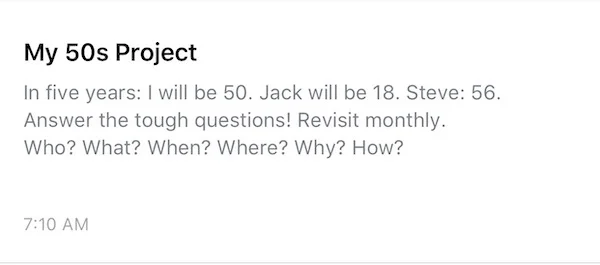
A note from Michele’s “50s Project” file.
After all that, what changed during this experience was that I no longer felt the self-imposed pressure to “go big or go home,” or that securing venture capital and growing a billion-dollar brand is the definition of success.
Don’t get me wrong, I have all intentions of building Excy into an amazing company and household brand, but I now find myself looking closely at brands like Tuft & Needle, MVMT and entrepreneurs like Rand Fishkin for an alternative blueprint for building a fast-growing company without VC.
You made a mindset shift to prioritize how you spend your time, especially with your family. You can still build a great company, but it requires you to re-think prioritization.
Shifting your mindset to time helps you understand what is realistically possible. To me, building a VC-scale business is a consistent commitment to 70+ hours a week to deliver the expected hyper growth (not including travel). I consistently put 70-hour workweeks in the first 10+ years of my career.
Now, I focus on what is possible with a 45 to 50-hour workweek, with the occasional need to go higher and to travel. There are a lot of people with super powers and a lot of support systems in place who can pull this off (a spouse who doesn’t work, grandparents, nanny, third-party services, etc.). My dad recently retired (my mom still works) and he helps out when I travel, but they don’t live close enough for spontaneous help.
At first, I felt like a failure for admitting that I just can’t do it and be the mom, wife, daughter, sister, friend, mentor, and even neighbor, that I want to be. I still fail at these things (typically many of them at the same time), which those who are close to me would tell you because I’m slammed, but I’m highly aware and working on it.
Also, I’m starting to plan on hiring the right team and getting the right investors who are on the same wavelength in establishing a realistic growth trajectory of our business.
What tradeoffs has this shift required of you?
It requires execution and not getting out in front of your skis. It also requires eliminating things that are not moving the business forward.
The smartest decision we’ve made so far is focusing on hardware first and nailing the design and usability. I was in a position to bootstrap the company through this point by working, using savings, sales, and good old sweat equity.
The second best decision was working hard to understand our customers' motives and barriers so that we can also design content that inspires for incremental behavior change. That brings results without asking for complete behavior modification.
Lastly, having a realistic growth trajectory and being very intentional in our growth requires a sustainable and creative marketing budget, realistic customer acquisition costs, and reinvesting the profits in the business to grow faster.
To determine marketing spend, I use revenue and profit-growth expectations to determine how much to spend. Business 101 stuff.
I’m a planner. I had a 5-year plan out of college. And then a 10-year plan. I’m ridiculously structured, sometimes to a fault, but there’s always a master plan. Getting caught up in the idea that building a VC-scale company was the definition of success was a total distraction from our intentional growth strategy.
We can continue to fund with revenue and profits but consider fueling with a smaller strategic investment. Cash is king after all, and while there is always a cost of bringing in outside money. The costs are different (also stressful) for alternative paths to VC. I am weighing those now.
You have a deep background in marketing and PR. How did you approach the marketing for Excy without the size of budget you were used to working with?
From the beginning I knew we could not compete with large consumer tech fitness marketing budgets and big, infomercial activity. Also, if I look at what traditional exercise companies do, it’s not fresh. It’s not new content to give people ideas and motivation.
So, my strategy has been to out scrappy them with content marketing that includes social, video, live streaming, and sharing customer testimonials.
I can compete on just going faster with authentic content, which means there’s no pressure to do things perfect. My customer base doesn’t feel perfect. I’m sure as hell not perfect. There is a craving for real people.
It was really hard for me to do video. I sat on it for a year. My entire career has been behind the scenes, so putting myself out there was very challenging.
When we did our Kickstarter, we had a great product with a well-built mobile app, but the future is in the content and being able to support and motivate people and make them feel a part of something. We started with six professional videos. I bartered, and in exchange I gave them PR services. Those early videos continue to be our most popular. Look at "Arm Candy," our most popular to date.

Excy’s most popular video. Watch it here.
Content strategy
So that six-video package launched your video empire. You are a video-producing machine, you must have over 100 videos, and you’re doing live streams. Talk about authentic—you are the brand and peddling-proof of the impact of your product. Video is the cornerstone of your strategy. What fueled that strategy?
My strategy with video is multi-faceted. First, I want to inspire our customer base to understand the power of what they bought and to put it to work. We didn’t build this device to be another dust collecting piece of exercise equipment. I feel like me rolling out of bed at 6:00 a.m. with no make-up or busting out a random workout outside on the go on demonstrates what’s possible.
Second, I want to extend our SEO footprint to increase traffic and decrease our customer acquisition costs. Google Search is our number one driver of traffic and sales. I put all our live videos to work on Facebook, YouTube and then push snippets to our website, email list, Twitter and Instagram.
Finally, with our paid professional videos, I want to showcase third-party credibility, teach customers how to properly use our device, and also capture that we are a professional company.
We put a very small amount of money into boosting Facebook Live videos on occasion for a decent ROI. I then do everything I can across all our channels to extend the longtail value of all the live content.
We haven’t paid for any YouTube subscribers or views and we’re well over 100,000 views organically. I do Facebook Live, YouTube Live and we capture the streams to our website. We use the top-level domain .LIVE (www.excy.live) to create a branded experience around our live content and to make it easy for our fans and customers to see what we are up to and to dive in to our vast library of content. We also make all the content easily discoverable in our mobile apps.

Excy’s Live page.
A lot of our customers are not on Facebook so we have to reach them where they are, including when they search the Web with a very specific exercise problem that we can help with. With video, they can easily determine if they can see themselves using our device.
Content production
What equipment do you use?
I have two iPhone 8 Plus smartphones, plus an iPad. I have a couple of tripod stands and use cases from Iographer to hold the phones. We recently started using Switcher Studio as our streaming platform to help brand our live streaming experience.
One of the challenges is that people don’t know we have a mobile-coaching app. Switcher Studio allows me to dual-screen and I can feature the mobile coaching app in action as my coach through all my workouts.
I do monthly challenges that customers can follow along with. Or I’m somewhere and I just go for it and pull out the Excy.
I love the video of you in New York across the bay from the Statue of Liberty. I felt like I was there with you, pals strolling the promenade. Oh hey girl, let’s get in some upper arm work while we marvel at this glorious representation of America at its most industrious. Does it come easy for you to do these videos?
At first, I was shy and embarrassed. Not because I was using Excy, but because of the setup with a tripod and talking to the camera as people were walking by. I’d find a quiet place. Now I don’t care. Well, maybe a little with looking like I am talking to myself, but now I just wave at people and answer their questions while on camera.
In my personal life, I have no problems riding Excy anywhere, including the sideline of my kid’s sports functions. Or in the airport. Wherever. I did have one man recently take a video of my using Excy on the sideline and he sent it to his wife. Her first reaction was “Great, an in-shape woman getting more in shape.” It can be hard to constantly remind people of my story and how I live with an injury, so this is why we also place a lot of emphasis on sharing customer stories.
Prior to Excy, maybe I took three selfies in my whole life. I was the mom who was never in the picture. I’d crop my head out. There was always something wrong with my body that I wasn’t happy with. I was that person. I’m not a photogenic person. When I have my photo taken it’s a struggle. It’s uncomfortable for me.
But now I’m more in touch with myself. My son will have more pictures of us because I give fewer fucks.
By the way, the Excy videos are also my workout. Those challenge videos are my real workouts. Or I workout while watching TV. I do weekend warrior stuff (skiing, biking), but I do Excy for 20 minutes, five to six days a week. And I go hard.
How have the videos contributed to sales?
I think the strategy led to nearly all our sales, including securing a relationship with Stanford Health Care. It also helps minimize returns. We’ve only had five returns. People understand how to use our system. As I mentioned earlier, it’s also helped with our SEO footprint.
I will say, I can’t watch the videos. It’s too hard for me.
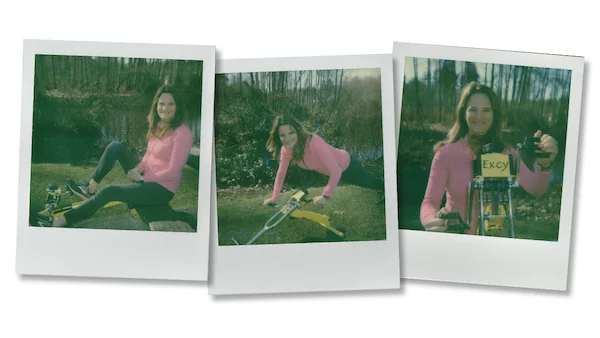
Michele in action.
Well, please know that your videos are incredibly inspiring. They make me want to buy an Excy and get me some abs like yours. Damn, you can plank AND ride that freaking thing at the same time. I wanna see you Excying, in a plank, while Jeff Bezos meditates on your back. Ommmm...
I love Amazon and Jeff Bezos, but lately, I just keep envisioning him naked with all this dick pic stuff, so you just freaked me out.
I consistently hear from our customers that these live videos inspire them, so it’s why I keep doing them. I’ll be 46 next month. I’m working harder than ever and I’m close to being in the best shape of my life by mostly exercising and multi-tasking when I would otherwise be sedentary.
My next goal is to leverage video even more to drive engagement and extend our footprint since fewer people are paying attention to social media.
Sounds expensive. I know you’re thrifty and crafty with your spend. How is all this possible?
We recently kicked off a new effort called HealthYeah by Excy. It’s a risk to introduce another brand, but we are using it to build out more expert content in a very authentic way (everything is live). The goal is to inspire people, but also drive email signups, engagement, and a great SEO footprint. We are three interviews into it and I am beyond happy, so I booked us out through June.
We will continue to pay our professional videographer to capture video, but also barter for videos, too. For example, I don’t pay our physical therapists to do videos. They do it because they believe in what we are doing, so I give them an Excy for their clinic to work with patients. We will also continue to do live workouts, less than before, but still keep building the library.
Bartering and trade—that’s such a startup theme. You have to get really good at asking for help. Since video is so important to your marketing and product experience, talk about how you integrate it into the app.
The mobile piece is interesting. All videos are integrated into the mobile coaching app under our “more” tab. “Live” takes people to live workouts and training. “Videos” takes people to physical therapy instructions. “Learn the exercises” takes them to setup and tutorials. That helps the customers have a good experience within the mobile app and since everything is also multi-channel, we use the same content to create an SEO footprint.
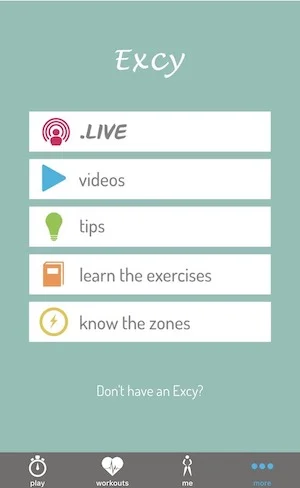
The Excy app.
When you’re an ecommerce company that’s both mobile and hardware, it’s a lot of products to manage. Social is a product, too. We are absolutely a content company.
From the beginning I wanted the hardware right. Then deliver the content. Over time it will be specific to injury and disease. There is a subscription model to be had in the mobile app. Peloton is spending tons of money doing this. They’ve closed almost $1 billion in funding. With my growth strategy, we will partner on the subscription front for the backend but drive the content ourselves with customers and experts.
Steady focus on sales, plow more into content marketing as you have the revenue—but you are profitable now, right?
We ebb and flow depending where we are in the inventory process. When we place an inventory order, which we just did, we’re not profitable until we start selling. Also, since I’m not paying myself, I technically don’t think you can consider yourself profitable until you’re paying yourself a salary. But we’ve made money every month since we launched. That’s hard to do.
There have been temptations to add sensors, or speed up my vision for the mobile app. We have to stay focused. It’s always tempting to do more. Our customers aren’t demanding it. Since I’m bootstrapping, I have time to listen to my customers.
Direct-to-consumer as a startup
Any lessons from your travels in direct-to-consumer land?
If I look at Peloton taking close to a billion dollars, or Mirror taking in $40 million-plus, it can be very easy to be demotivated knowing that D2C is extremely expensive. We are choosing to swim in blue waters ignored by the shark invested fitness market.
We’ve been able to work with health systems and physical therapists rather than celebrities. Another part of our strategy has been to build authentic relationships with opinion leaders who are our customers and have high credibility. That gives our core audience a level of confidence.
My photographer managed to talk me into one photo with a sports bra while planking. I prefer to just capture real life moments where fitness is possible without the production of perfection. It’s a very different strategy than other exercise companies.
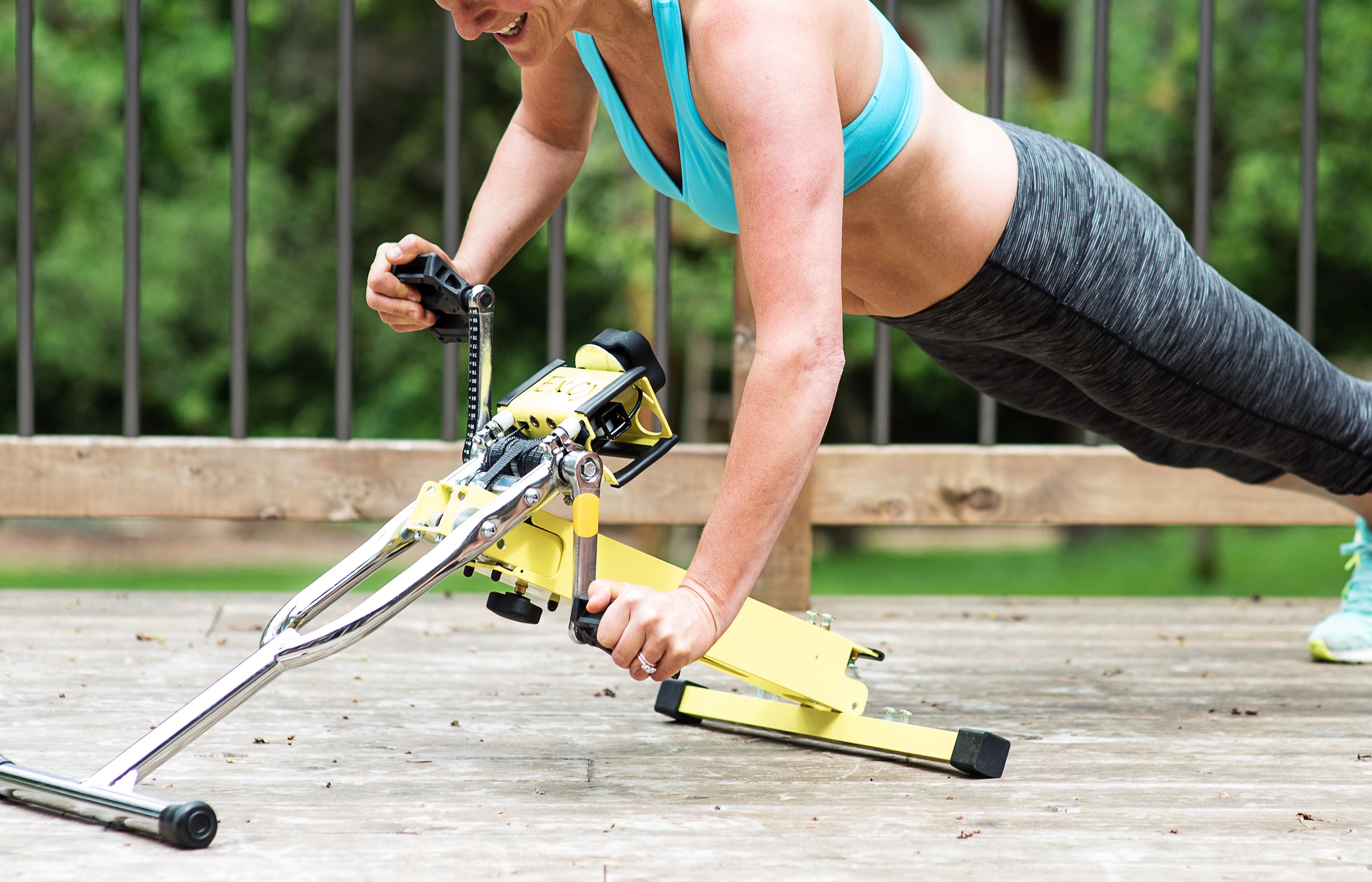
I also don’t want Excy to be a fad. There is a tsunami of age-related issues. Exercise is a giant component of that. We can make a contribution to the long-term care of baby boomers and people battling diseases, including many preventable diseases. Now we have the device in place. We have a second product. We have two patents. We will change the nature of how people will take care of themselves.
If I had taken on money our mobile app strategy would’ve been different. We would’ve had to have subscription-based content already before I knew the customer.
Growth trajectory
Final question, who or what has impacted your trajectory the most?
Wanting to be there for my son as he pursues his own dreams and not wanting to miss it. My husband has a very demanding job and travels a lot. It’s hard for both parents to burn the candle from both ends, especially without extended family nearby readily available to help. In close coordination with my husband and my co-founder, we have crafted a realistic growth trajectory that allows my husband and I to raise a busy teenager.
Startup survival tips
Michele’s advice:
Be willing to get outside your comfort zone. Prior to starting Excy, I spent my career behind the scenes. Now, I am doing live training sessions. It’s so awkward, but it helps our business.
Avoid the peaks and valleys. The peaks are high and the valleys are low and lonely. The best way to avoid this is purposeful activity that drives the business. When you find yourself being inactive, do something, anything productive to keep motivated. Even better if it’s time on high-yielding sales efforts.
Don’t get caught only doing the things you are good at. This goes back to the first one of getting outside your comfort zone. Example, I am a better marketer than I am a sales person. But marketing alone doesn’t move the needle. You have to focus and do the things you aren’t as good at too. Or, hire people to help.