

Richa Prasad: How to grow fast without VC funding
Richa Prasad, CEO and Co-Founder of Coach Viva on the strategic mindset shift that can help you drive profitability without venture capital.

Richa Prasad, CEO and Co-founder of Coach Viva, details how to shift your business model from growth to profitability and seven steps to grow fast without VC funding.
Editor’s Note:
This is not fast, snackable content. This is control-your-own-damn-destiny content.
Underwire is honored to feature the writing of Richa Prasad. A former AI engineer at Microsoft, Richa co-founded Coach Viva with Lucy Liang. This article details Richa's journey through early stage customer acquisition for her AI Health SaaS startup. The strategy and formula she details will work for most companies—digital products, ecommerce, professional services, etc.
With women-led businesses getting less than 3% of venture funding, no one is coming to save us. If you're serious about building a viable business, study this article and apply the lessons to your marketing mix.
I come from a deep product background. Electrical engineering. Computer science. Internship at Philips Semiconductors before they shut down. At Motorola before they got bought by Google. A full-time gig at Microsoft working first on Visual Studio and then Cortana.
I read widely about all aspects of tech. I dogeared the entire Lean Startup series and books of similar ilk that you’d find on top of Product Hunt Books. I subscribed to Y Combinator and the whole Silicon Valley advice engine, and at some point I began to believe that I understood what are all the pieces of running a business in breadth, even if not in depth.
I left Microsoft to fill a gap I see in the personal health and fitness market where coaches cost exorbitant amounts of money and yet aren’t available at the very moments when people need them the most - moments of failure like when you’re shame spiraling from eating far too much, moments of indecision when you’re standing in line to order your food and don’t know what’ll keep you perfectly on-track, and moments of exhaustion when the journey feels far too hard and you want to give up.
A year into running my company, Coach Viva, my cofounder Lucy and I ran into what we all grapple with - growth. Our word-of-mouth was solid but it was nowhere close to a viral coefficient of 1, the threshold beyond which you can be assured that your product will grow fast on referrals alone; no other marketing channels needed. We tried ads, partnerships with other businesses in the health niche, a tool to attract leads, a pilot with Amazon Benefits, an in-product feature to promote referrals, and much more, but still we struggled with getting a steady stream of incoming customers.
It was in the midst of Summer 2018 while I read, watched and listened to marketing advice from literally anyone who makes their entire living online when I stumbled upon this whole world of entrepreneurs creating 8+ figure businesses without VC funding. They said things that made me realize there is a whole other way of doing things outside of what Silicon Valley talks about.
This story is my distillation of what I have learned with emphasis on the parts that completely changed how I think about building a business.
I am very early in implementing what I’ve learned so you aren’t going to find a “it works for me, let me show you how it’ll work for you” story. My goal isn’t to give you proof. My intention is simply to expose you to a different way of building a business than what gets airtime in tech circles, and leave it to you to decide if it’s for you.
Part I: To fund or not to fund
When I tell someone I am a founder, their first question is, “What does your business do?” followed immediately by, “How much funding do you have?” Not a surprising question given that I see one month old tech companies circling funding events.
I have to admit funding is one piece where what made sense to me versus what I saw happen around me felt disconnected. Not so much in “Why one needs funding” but more in “When one needs funding.”
Lucy and I felt we were in a niche where at our early stage, VC money didn’t seem like a necessity to finding product/market fit or fighting off competitors. We also weren’t sure if we were ready to commit to growing at the crazy pace VCs expect. And lastly but most importantly, the process of getting funded seemed like a huge distraction from what we needed to focus on most - building traction.
This brought up the question of how do we grow fast enough that we don’t run out of our meager, bootstrapped runway?
As you may or may not know, SaaS businesses are notoriously slow going for the first 3-4 years. This is especially true for a B2C SaaS model like ours where each sale is in 2-3 figures, not the 4+ figures each B2B sale brings in. Add to this that we’re selling weight loss coaching where churn is naturally high due to customers’ life priority changes and meeting the goal they signed up for.
Searching for answers to these existential questions far and wide, I came across Russell Brunson, who grew his company ClickFunnels from 0 to 360M in 4 years without any VC funding. I started digging into how he did it and that’s when I learned what I’m about to share.
Part II: The foundation of profitability vs. fast growth
There are 3 foundational blocks to understand about his success. The first two blocks describe the business and mental sandbox you’ll be playing in should you choose to follow his approach. Use them to judge if this is the right path for you. The last block lays down the strategy to follow if you decide on this path.
Business sandbox: Constraints you agree to build your business within.
Mental sandbox: Silicon Valley mindsets you agree to discard.
Your strategy to growing fast without VC funding.
Business sandbox
Firstly, let’s talk about which businesses aren’t a fit for this path. If your company is in a commodity-like industry that doesn’t inherently have enough differentiation on day 1, then what I’m about to share won’t work for you.
Social networks and ride-hailing services are two examples of businesses that don’t fit this model. These types of businesses rely on lots of cash to grow fast and monopolize a market before their competitors, and that monopoly becomes their lifeline. They need VC funding to accomplish this.
Compare this to a service like Coach Viva where there is inherent differentiation in coaching services. You pay Tony Robbins a whole lot more than a life coach off Yelp even though they both provide the same service. In contrast, Lyft and Uber are largely interchangeable and rely on coverage and price wars to attract and keep customers.
Second, your focus is to build a profitable business, not a high valuation business. You can always decide later that reaching escape velocity has become critical to your business and you need to attract VCs, but when you’re in midst of pursuing the strategy I describe in foundational block #3, you’re primarily tracking profits, not pure growth.
For what it’s worth, if you choose to not pursue the VC path ever, it doesn’t mean you won’t have massive impact on the world. Perhaps the most famous example of such a person in the Silicon Valley bubble is Gary Vaynerchuk. He's funded many startups including Facebook, Twitter and Venmo to name a few, but his own company, Vayner Media, has never taken any VC money.
Lastly, non-VC backed companies grow fast - ClickFunnels and Vayner Media for example - but they aren’t going to grow as crazily fast as VC-backed companies because they don’t receive overnight millions of dollars to burn. Comparing the two is like comparing a natural bodybuilder to a steroid-fueled one.

Natural / Non-VC vs. Steroid / VC
Mental sandbox
All the mindset shifts I am about to list hinge upon the change in business model focus: profitability, not pure growth. If you’re going after pure growth, Silicon Valley advice is the perfect advice for you. However, if you’re following this fast bootstrapped path, then you will need to make the following mindset shifts.
The first mindset you’ll need to shift is your attachment to the narrow scope of the problem you’re trying to solve. Instead, try to serve your market in whatever way possible.
Let me explain.
When I first started Coach Viva, I was attached to making real-time weight loss coaching affordable for the masses. This is exactly the type of focused problem that startups get funded for.
But let’s be honest:
Not everyone who is trying to lose weight needs coaching.
This sort of business naturally has high churn because the point of coaching someone is to help them become independent.
If I poke my head up and look around beyond solving coaching, I see a whole slew of customers who'd pay for kick-ass DIY weight loss tools and courses. Bonus: I will become profitable, thereby extending my bootstrapped runway, far more quickly if I try to serve my market in whatever way possible like building the aforementioned tools and courses, and thus disconnecting my business’ success from sales of my coaching service alone.
This brings me to the second mindset you’ll need to shift: sell (almost) everything. Most VC-backed businesses are set up to revolve around one main paid solution with different pricing tiers while everything else gets distributed for free.
Now I’m not saying charge for content marketing. You need to have free relationship-building stuff out there, but don’t only charge for your main solution. For example, at Coach Viva, we sell courses and we’ll sell DIY tools soon, even though our “main” product is coaching.
I touched upon the third mindset briefly just now but to call it out explicitly, don’t marry yourself to selling only software. This is a product-person mindset trap. Sell whatever type of solution your audience needs. In our case it’s also courses and physical workbooks. You're seriously under-serving your market if you are married to only selling software.
And the last mindset you need to shift is thinking your product is not your offer. Those are two very different things, and to build your offer, the different solutions I’ve been talking about for you to create for your market play a critical role.
Here’s an example: let’s say my product is a cup. If I try to sell my cup on Amazon, I’m in a price race to the bottom. Now let’s say I decide that this cup is for folks drinking coffee who are busy and are fueling themselves throughout the day. Now I can create an offer that includes my cup + meditation practice tracks + a thermos + coffee recipes for energy, and price this offer whatever I want as no one else has my exact offer.
Ta-da! I’ve broken out of price wars and created a brand around my product in one fell swoop.
PART III: The strategy for growth - your prospect’s journey
If you are 100% comfortable with both the business and mental sandboxes you’ll be playing in, then welcome to the last foundational block - the strategy to nail for growing fast without VC funding.
Your strategy can be broken down into the 7 steps in your prospect’s journey.

Source: DotCom Secrets Book
For each step, I am going to lay down the principles you need to think through for your own business. The distillation from principles to tactics to experiments is your domain, as it’s subject to the needs of your business and wide open to your creativity in how you implement them.
Let’s dive into each step.
Step 1: Traffic Temperature
First, there is Hot traffic - these are the people who are actively exploring your direct competitors’ solutions. For example, if you’re selling Mud Run tickets, these are the people who’ve already done mud runs before or are looking for mud run events right now. They are the easiest people to sell to as they already believe in your worldview of “mud runs are awesome and important”. When you target these people, you’re ‘collecting’ customers.
Next, there is Warm traffic - these are runners who need convincing as to why mud runs are awesome. There is education you need to provide to bring them over to your worldview.
Last, there is Cold traffic - these are people who have never ran a race. They aren’t certain if running is something they’ll commit to, and mud runs are far from their sphere of understanding. When you target these people, you’re ‘creating’ customers. Converting these people into your customers is really hard.
As you can already guess, you want to first exhaust Hot traffic. Too often we start going after Cold traffic because we want to “change the world.” No. Go after the easiest niche you can think of.
In fact, divide your niche into sub-niches, and target the Hot traffic in each sub-niche. For example, for Coach Viva, the people exploring Noom and Weight Watchers are Hot traffic. We should go after them as they already believe in our worldview of “You need awesome coaching/accountability to make weight loss stick.” Once we exhaust that sub-niche, we could go after the Personal Trainer sub-niche. And so on.
For each sub-niche, you could in parallel go after Warm traffic. This happens through partnerships with shoulder sub-niche businesses, that is, businesses that target the same customers as you but sell something that’s not in competition with you. For example, athleisure shops are a shoulder sub-niche business for Coach Viva.
And lastly, Cold Traffic is where you’re literally trying to create a market - not collect people anymore. You’re telling people they have a problem and should want your solution. This is where building a public presence through blogging, YouTube, podcasts, books and social media is important since you won’t see returns on these investments for years due to two reasons: (a) organic channels like these rely on compounding effect which means time is essential for them to grow, and (b) the prospects who come through these channels require the longest education time into adopting your worldview.
Step 2: Pre-Frame Bridge
The Pre-Frame Bridge is the education you need to provide to your incoming prospects so they can shift into your worldview and be open to your offer. A Hot traffic person requires a shorter pre-frame bridge than a Warm person, who in turns needs a shorter bridge than a Cold person.
For example, Coach Viva gets Hot traffic from weight loss Facebook Groups where our existing clients refer us to members in the group who asked for a good coach to try. These members tend to click the “start free trial now” button on our landing page with the highest frequency.

A typical landing page
It’s a different story for Warm traffic from our Yelp page. Since Yelp is about in-person businesses, the prospects are in the frame of mind of wanting an in-person trainer. We need to first break that frame and persuade them into a new frame that tells them they can be just as successful with an online coach. So, the first page they see needs to be devoted to this reframing education. It can't be the typical landing page with a "start free trial now" button.
Finally, when Coach Viva gets Cold traffic from Google, the prospects mostly want to learn more about us. We need to first understand what they are looking for, do we have anything that helps them, and build trust by sharing our stories and knowledge before that landing page with the “start free trial now” button can be shown.

Coach Viva About Us: share stories to start building trust
The point I am trying to make is to think of your website like a salesperson, not a brochure. A salesperson speaks in context to where their prospect is at. She doesn't just hand over a 50 page brochure and sit back and wait for the prospect to decide.
Steps 3, 4 & 5: Frontend of your Value Ladder
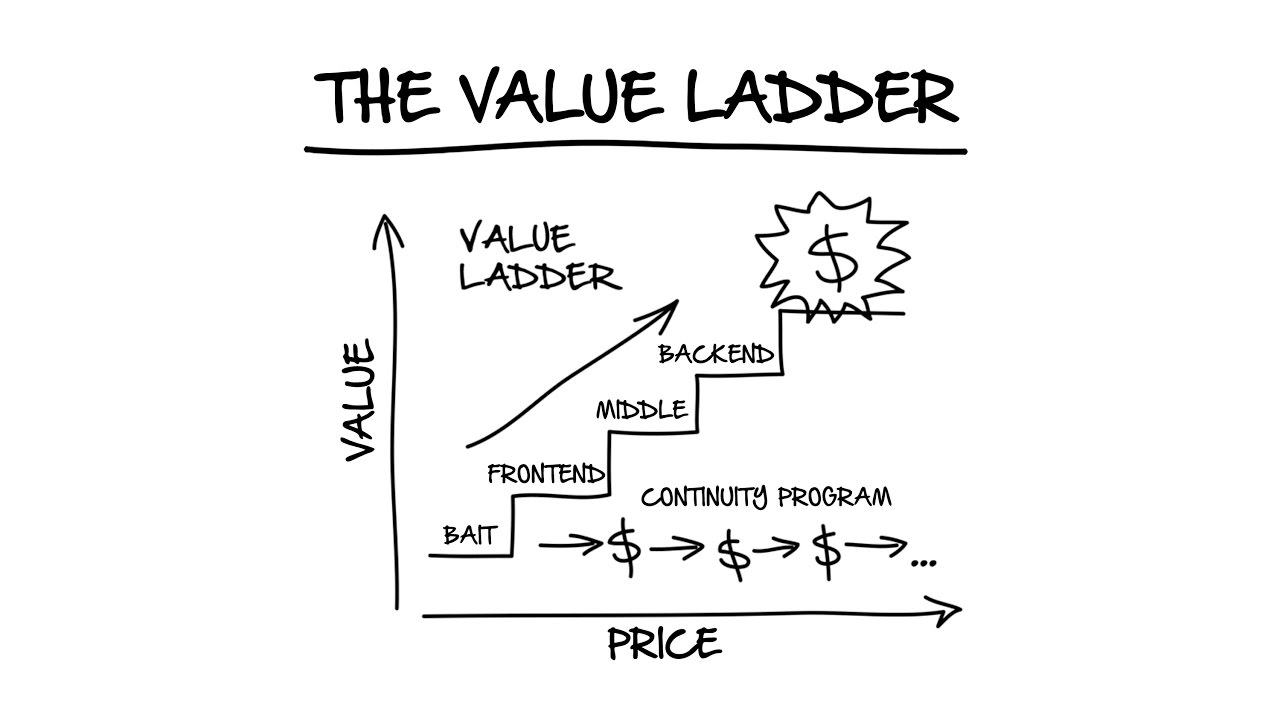
Now that your prospects have gone through your pre-frame bridge and understand your worldview better, you are ready to make offers. The order in which you make your offers is important, and is collectively called the Frontend of your Value Ladder.
Source: DotCom Secrets Book
The first step in your Value Ladder is the Bait, as in the thing that causes them to pause and click on the link to your website. For example, our Yelp page reviews are a bait. If you do ads, those are baits. A bait is your content appearing on other platforms, hooking your prospects in by being intriguing, and then reeling them onto your website.

Bait to hook people and then reel them into Coach Viva’s Frontend
Once they are reeled onto your website, they proceed through the pre-frame bridge and then to the second step in your Value Ladder, called your Frontend. This is collectively Steps 3, 4 and 5 of the 7 steps, which happen in the same session, so you catch all the people who’re ready to buy.
3. Offer your prospect something of high-value (example: an e-guide on how to break weight loss plateaus) in exchange for their email / some way to connect with them without algorithms you don’t control getting in the way. The goal is to, at worst, have a way to continue building a relationship with them, and then point them to step 4 again if they didn’t buy the first time around.
4. Offer your prospect something of high value for cheap that builds upon your offer in Step 3 (example: a comprehensive book on how to DIY fitness for $5). The goal is to test the waters to see if this prospect is already bought into your worldview and ready to buy right now.
5. Offer your prospect something that's more expensive and makes your offer in step 4 faster, better, stronger (example: a personalized nutrition and exercise plan for $50 so they don’t have to spend time translating the book to actions in their life). You’re targeting buyers in heat - for example, I was one when I went to Amazon to buy one book to learn design, and ended up buying 3 design books because they all looked so helpful.
You can collapse steps 3 and 4 into one step (example: by selling a physical product that’s free as long as prospect covers shipping cost) or skip step 5 altogether at the beginning. Step 4 could also be someone else’s product with whom you split revenue.
There is a lot of flexibility in how you implement these steps as long as you satisfy the two goals of the Frontend:
A. Create offers that make your CAC = < Revenue from your Frontend.
B. Your Frontend converts your prospects’ beliefs into your worldview.
Let’s dive into A first as that’s the lynchpin of how you can grow fast without VC funding.
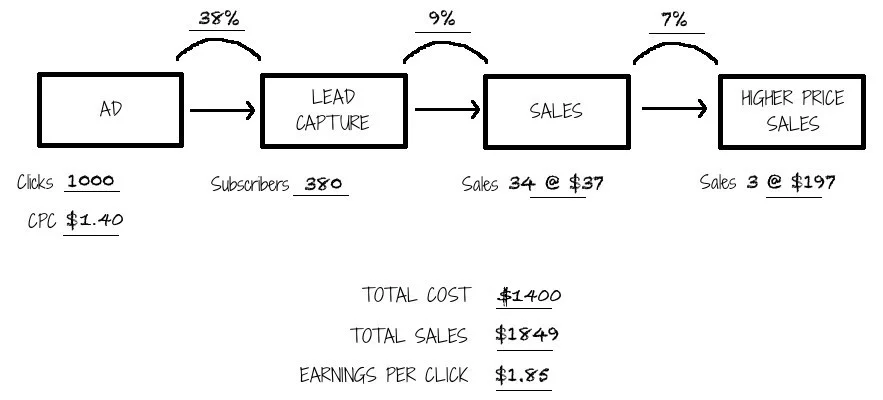
For the sake of easy CAC calculation, let’s say you’re using ads as the bait to drive traffic to your Frontend. We’ll assume that the ads are costing you $1.40 per click, which means it costs you $1,400 to drive 1000 prospects to your Frontend.
Now let’s say 38% of the prospects gave you their email in Step 3, which means you got 380 subscribers. Next, either when you showed Step 4 after Step 3 or through your relationship building sequence of communications leading them back to Step 4, 9% of subscribers bought your $37 product. Your total sale is $37 x 34 = $1258.
After that, let’s say 7% of your buyers also purchase your $197 offer in Step 5, which brings your total sale to $1,258 + (3 x $197) = $1,849. This equates to $1.85 earnings/click which is greater than your cost of $1.40/click. You have a winning campaign where you’re making a profit!
Source: Fill Your Funnel Secrets Book
Let me repeat the two important points from this example:
If you were only selling your first offer of $37, you’d be making a loss ($1.26 earning/click vs. $1.40 cost/click). It is the sequence of offers building on each other which helps you beat your ad costs. If you’ve read any negotiation book, you know that once you get the first Yes, it’s far easier to get subsequent Yes’ on bigger and bigger asks.
You’re getting paid to acquire customers. You can literally outspend anyone to get customers. You see now how you can grow fast without VC money?
Now let’s talk about goal B (your Frontend converts your prospects’ beliefs into your worldview) which compounds your growth and profits created by goal A.
The actual offers you make in your Frontend must make your customers your huge fans. This means two things:
They cannot believe how much value you delivered for how little you charged them.
The value you gave educates them thoroughly into believing your worldview.
That last bullet is especially important when we get to Step 6, where you multiply your Frontend profits while having $0 CAC.
Step 6: Age & Ascend the Relationship
At the end of your Frontend, you have a customer, that is, someone who has already bought from you and helped you acquire other customers at profit.
At this point you pause on the sales and nurture your relationship with them by sending them high-value emails / whatever direct communication channel you choose to deliver them entertainment + value. You tell them stories about yourself, share what you’ve learned, what you’re doing, your failures and successes, and essentially get them to know you better.
Once you feel they’ve been nurtured well, you now ascend them to the Middle of your Value Ladder. This is the natural next thing they need in order to make use of your Frontend.
For example, Coach Viva’s Frontend are courses which teach people the science and DIY methods of how to lose weight. A natural next thing they need are the tools which make implementing said methods easy and quick.
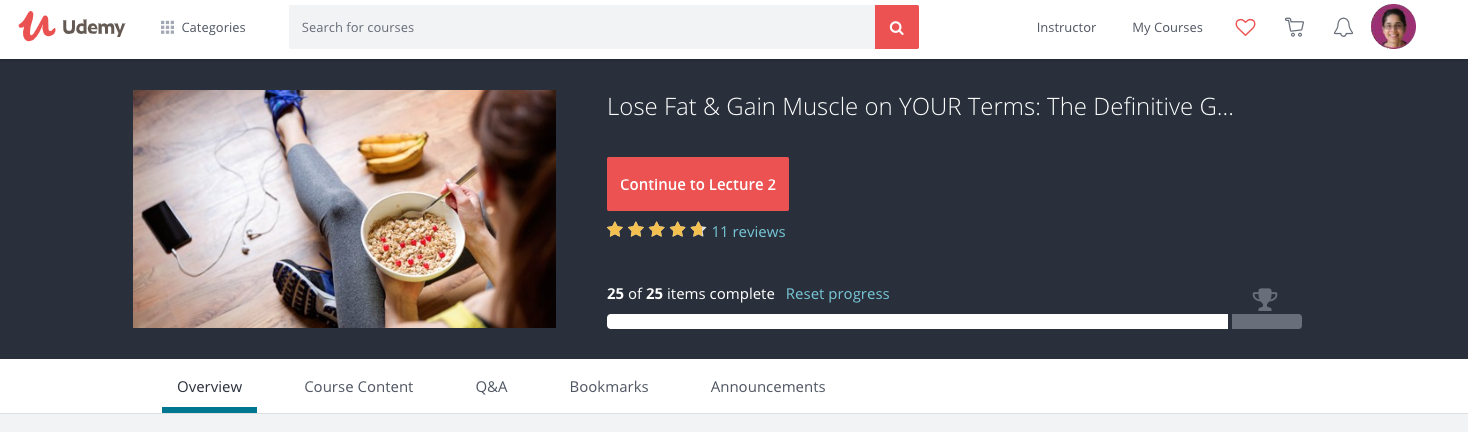
Frontend course of Coach Viva
If your Frontend did a good job of converting their beliefs into your worldview, these customers will be primed for your Middle Value Ladder, and guess what, selling it to them costs you $0! It’s pure profit from here on out as you age and ascend your customers up your Value Ladder.
Your Middle Value Ladder could be one offer or many. For example, at Coach Viva, our tools are our first Middle offer while coaching is our second Middle offer.

Frontend course nudges students to review what they learned by taking a quiz hosted by Coach Viva, which then seamlessly leads into offering the Coaching Middle offer
At least one of your Middle offers must have a continuity revenue model, that is, be a recurring source of revenue. For Coach Viva, we plan to have both Coaching and Tools have a continuity revenue model.
Also, remember the mindset shifts we talked about: this could be not just software, but a membership site or information product subscriptions like magazines.
Step 7: Change the Selling Environment
Throughout Step 6 you’re nurturing your audience with email / other communication methods, and at some point those who bought your Middle offer(s) will be ready for your Backend offer. This is generally a high-ticket offer in the 4+ figure range, which is why you need to change the selling environment into a phone call or some such 1:1 communication to make the sale.
Just like there can be multiple Middle offers, there can also be multiple Backend offers. These are generally offers where you are "physically present,” like a consultation or retreat or mastermind. In fact, as you gain fans, you could start putting together virtual or in-person Backend offers, and see who bites. You don't have to wait until your Frontend and Middle is profitable before experimenting with this.
Last note
It's okay for prospects to jump directly into Middle or Backend if they are ready. Not everyone needs to go through the Bait to Backend in sequence.
However, it’s interesting to note that both Russell Brunson on his podcast and Rand Fishkin of Moz in his book have remarked how the customers who go through the education journey from Bait to Backend tend to be on average the highest LTV customers.
Where we are at with Coach VIva
We are still in the process of figuring out our Frontend that meets the two A and B goals mentioned above as well as setting up our public presence, that is, the Cold traffic sources.
One of our frustrations with 2018 was we set goals that aren't directly in our control, like revenue or customers.
In 2019, we have set a goal to do 100 needle moving experiments (50 by me, 50 by Lucy). All must be “skateboards” in Spotify MVP language, and they must target whatever happens to be our bottleneck in the 7 step customer journey at the time of the experiment. As a byproduct of this consistency, we hope to see the out-of-our-direct-control goals move in the right direction.

A gift for you
When we first started, ironically despite being a health business, both Lucy and I stopped exercising, sleeping or eating right.
In the past 6 months, we have reversed a lot of our slips as they were causing noticeable drops in our energy levels and mind clarity.
We know that you, like us, are super busy running your business, and don’t always have time to do the prep work (meal planning, workout program creation, building systems for self-accountability) that’s required to upkeep your health and fitness.
That’s why we’ve created a short quiz that asks you 3 quick questions to first understand, then offer the kind of help you need most right now to make keeping your health and fitness up easier.
That’s it from me for now. I hope this has gotten your brain whirling with possibilities. I’d love to hear your thoughts! You can reach me here.
Dani Cone: Bricks, clicks & kicks
Dani Cone, CEO and Founder of Cone & Steiner General and Fuel Cofffee on e-comm expansion, self-care fails and shit-tons of money.
The CEO and Founder of Cone & Steiner General and Fuel Coffee on e-comm expansion, self-care fails and shit-tons of money.
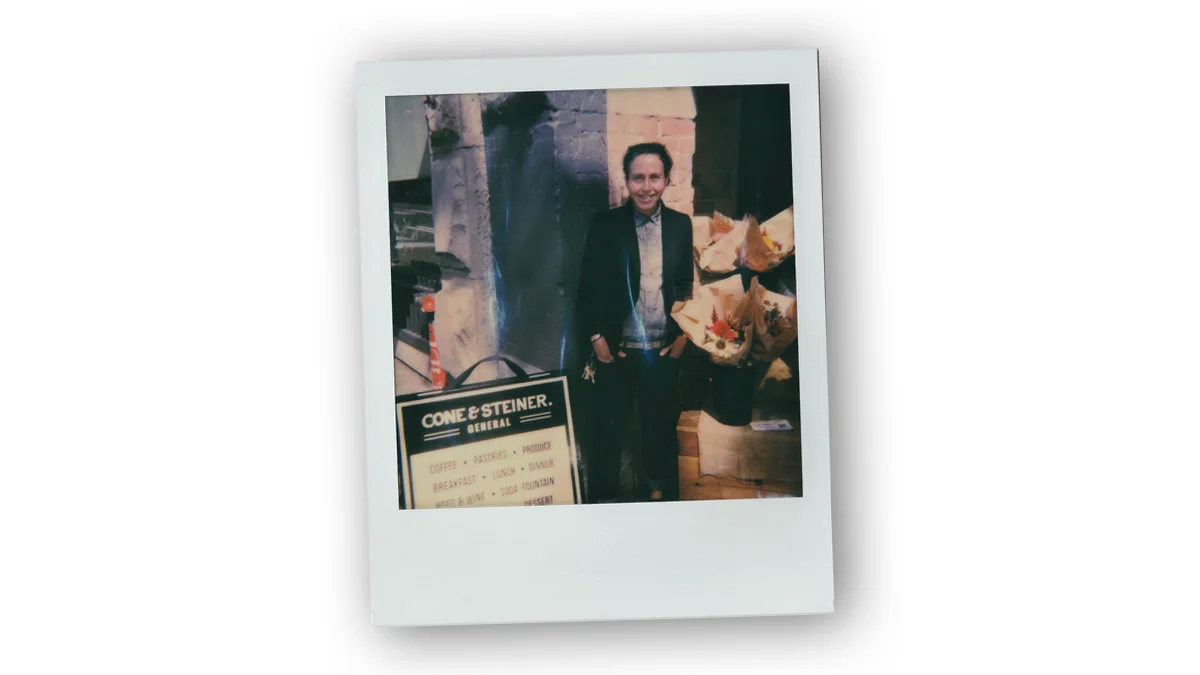
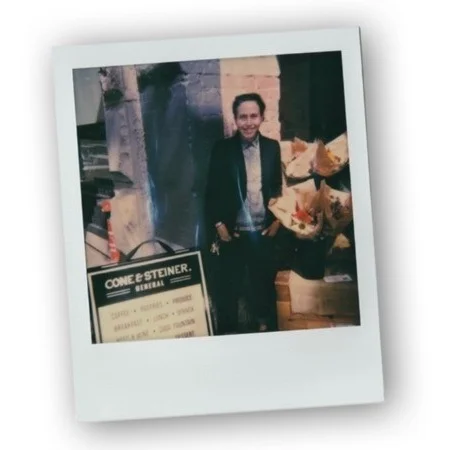
Dani Cone, outside the Cone & Steiner General downtown Seattle location.
Dani Cone oversees six brick-and-mortar operations — three Cone & Steiner General stores and three Fuel Coffee shops. The idea behind her empire is simple — take care of people with good food, drinks and staples.
To support the growth of Cone & Steiner General, Dani raised money to launch an e-commerce platform and delivery service. It’s in beta while the team works out product assortment and logistics.
Dani built her companies on a tried-and-true retail business models. She uses city data and trends analysis to inform where she sites locations. The e-commerce and delivery service grew out of customer feedback. The team stocks high-quality specialty and local brands, democratizing shelf space in a time when we want our SKUs to tell a story.
Some founders fit a classic archetypal character. Dani is an Everywoman. To the core of her being, she is the good neighbor. Grounded, unselfish and friendly, her brand embodies a place of deep comfort where all are welcome.
In our conversation, we talk about:
Near-term focus on adding revenue with e-comm and delivery, and how that widened the investor pool
What a $1.5 million Seed round funds in retail
Trends in retail, food and beverage
Justifying the cost of getting pro help, be it financial, coaching, etc.
Dreams of big exits and what money might buy
Underwire: What’s been going on since we talked in the summer of 2017?
Dani Cone: For starters, we opened the downtown Cone & Steiner (1012 1st Avenue) at the end of July in 2017. When we were talking, the plan was to open store three. I had done an initial capital raise to open that store and build out our internal infrastructure. That’s what that small $650,0000 raise was allocated to.
We built out the management team and buyers, opened store three, and then the plan was we’ll go from store three to then pursuing the Series A round for the larger expansion of multiple units to reach scale.
What I noticed in being the data nerd that I am and really digging into the business models, store performance and marketplace trends, was that instead of jumping to a much larger Series A round and reaching a significant economy of scale across five units, what we really needed to do was accelerate our plans to do delivery and e-commerce.
That’s what people are wanting, that’s what we’re getting inquiries for, and of course the worst thing in customer service that you can say is “No,” especially in this downtown location where there’s a dense urban daytime population, twice that of what we have at the Pioneer Square store.
People call all the time and they say, “I want to order lunch for the office, 30 sandwiches.” I say, “Outstanding, when would you like to pick that up?” I always hear the same response, “Oh, you don’t deliver? I don’t have anybody who can come pick it up, we can’t leave.”
There are only so many times I can pack the bag and run up the street. I thought, okay we’ve got to accelerate delivery and e-commerce.
All of that to say instead of jumping from a small capital round and store three to a big Series A round, I inserted this smaller round of $1.5 million to do two more stores, which gets us to that five-unit economy scale, again for our model, and launching the delivery and e-commerce platform. Right now, we’re at about $850–900,000 raised of that round.
Is that considered another seed round?
On the advice of my attorney it has been titled a Series Seed. Or second seed. But he mentioned that sometimes if you say “second seed” that sounds like maybe something didn’t go right with the first seed or we didn’t reach our goals and instead it’s just we’re trying to message it appropriately to say we’re adding this in intentionally before going to a Series A, otherwise it’d be a very small. It’s just not at Series A level.
With us being new and proving out the concept with this store, we’re still too early to attract the institutional investors that you would typically find in a Series A, or in a venture-capital raise. We’re a bit too early for venture.
How’s the e-commerce site build going?
I feel like a dinosaur trying to enter a whole new world. We’re starting out small and based out of the downtown store for the pilot.
We have a small radius and the offerings online aren’t the 3,500 items that we have in the store, but rather a very curated version of those. We have the top-performing categories that we think will translate digitally, similar to the experience that you would have when you come into the physical store.
Hopefully when you walk in the door it feels good, if it feels like neighborhood and community and anything you pick off the shelf is gonna be good.
You wouldn’t necessarily walk in and upon first glance of the store think, “Oh, I bet they have 25 kinds of ketchup.” We don’t and we’re not going to. Where do you draw that line between should I have three kinds of those, or just two? Why do I just keep the two?
There’s a lot of conversation and editing. Certainly many of those options are informed by sales data, what sells best, how often, etc. It also has to be that the feel is representative of the overall brand experience. Those are the conversations we had as we whittled down to about 200 items available online.
Will delivery be limited to certain times a day?
To start out with, yes. It will also have our house-made and prepared food items so you can order your office lunch of sandwiches or other people’s sandwiches. Or order ahead for catering, pastries, coffee, and things like that.
One unique thing I was able to do after many hours spent on the phone with the Washington State Liquor Control Board is get the licenses to deliver beer and wine.
Happy hour! That’s huge.
It is huge. Especially because beer and wine are one of our top three categories.
Across the street from the downtown store is a tower of residential units. If someone living there says, “You know what, I just want some great wine and cheese to celebrate,” we can do that. We do a couple of gift packs and a happy hour pack. Just add friends and there you go.
What was the spark for expansion into e-commerce and delivery?
A couple of very simple yet big things. One was the actual direct demand from customers, getting emails and phone calls of, “Can I order this online? Can you deliver this? How can I …? When can I …?”
And then parallel to that are the trends across e-commerce, and especially in food. Some of the statistics behind the trend are that online food sales are growing 35% year over year, and that’s just in gross rate.
When you add on top of that people ordering food to be delivered from Uber Eats or anybody really, Caviar, etc., it’s the way that people are shopping, eating and drinking. That’s also very aligned with our whole model in terms of being a modern-day convenience store.
It means something different than it did when convenience stores started. 7-Eleven, that started 70 years ago. It was convenient because as people were spreading out into the suburbs, they were driving cars and they needed something along the way. Now as people are moving back into the cities, we’re placing ourselves in these dense daytime population locations to be where the people are.
This is the new face and location of convenience, and also reflected not just in the location but answering the question, “What do modern consumers want? How do they want to eat and drink and shop? What are they looking for?”
There’s always a time and a place to have a Coke, nothing wrong with that, I love a Coke. But sometimes you want something else, or you want to show up to a party with something different or unique, or something just branded. Story is certainly a new form of currency.
Let’s go back to the money dance. It takes outside support to grow in the way you want to grow. Between that initial seed and this new round, what have you learned?
Oh my God. What have I learned without swearing?
You can swear. We swear on Underwire.
I’ve learned so much. During that first round, with it being my first foray into a world of raising capital, it was bananas, absolute bananas.
I felt more equipped going into this round because I knew more of what to expect. That said, fundraising is difficult on so many levels. There’s difficulty in our concept being brick and mortar, retail, food and beverage. I was very successful at stacking the odds as high as possible against me. Even by adding in the delivery and e-commerce piece, which is just this thinnest skim of tech that opens me up to a few other investors, but not as much as an app or something straight up tech, that’s a lot more appealing to folks in this city.
Then there’s the level of difficulty with the business model itself. A lot of folks in our investor community come from tech. When you see our numbers and our model, it does look very different from tech. Yes it scales, yes there’s a great return, yes there’s a market for it. All of those things, but yet it’s a different timeline. Like I said, the delivery and e-commerce does open us up to other folks who really get e-commerce and delivery.
Other things that I’ve learned about fundraising, as everybody always says, truly it is about reaching out to your network and then their network and their network.
You just have to keep talking about it to everybody you see at any time of day, even if you think there’s no way this person would be interested in even hearing about what I’m doing. You just keep blathering on about it because you never know. You just talk about it constantly, you tell everybody, you throw yourself out there shamelessly and say, “I’m raising money here, I’m raising money, guess what? I’m raising money.”
I think in any sort of business that you launch, you have to leave ego way far behind. That cannot be a part of it, especially in fundraising.
How does that feel to be in the state of constant talking about yourself and the business?
It’s mixed. I love what I do, and so I do love talking about the business and what we’re doing. Sometimes those conversations go great, and you get to meet amazing people and you start feeding off each other. I leave those meetings even more excited and energized about my own business than before, which is saying a lot because this is all I do and all I think about. That’s when I’m so grateful to this sort of process, because that’s how we make connections.
Then there are many other meetings that are like, oh just my gosh, you hear so many “No’s.” You get so much pushback. You hear that that will never work and all of these negative comments, and you just feel shredded, just shredded. It’s hard to keep up.
I know what we’re doing, I know its place, I know that personally, I know it in my gut. But I also know it is based on data and market and industry trends. I see what else is going on in the world and how this fits in.
I can really dig into that, but at the same time there are days when that gets really hard, it’s like, I’m so fucking tired of trying to tap in to my own depleted reserves to be the person trying to convince everybody that I know what I’m talking about.
I do know what I’m talking about, but of course I doubt that after many meetings where people are like, “That just doesn’t work right now” or, “If you really wanted to make a go of it, you’d be making ten times what you’re making now.”
How do you refill the well?
I very much fail at that. As my mom will tell you, I am just not good at that. I guess I just try and keep moving. This week has in so many ways just brought me to my knees. What do I do?
This morning I was talking to my dad, Gary Cone. He checks in every Friday on his way to work and has for 14 years since I started a business. It’s amazing. Just 15 minutes, he stops by on his way to work, whatever store I’m at. We have these little business and catch-up chats.
We’re sitting at the end of the bar this morning and I’m near tears and I was telling him all these things that happened this week. I don’t even know what steps to take. Usually I can think of something. You get scrappy, you get creative when backed into a corner, you just come out swinging. This is one of those times that even I feel just stumped, like holy shit.
Do you think that maybe it’s as much exhaustion as the business situation?
Absolutely. I’m tired, sure. I have the worst sleep schedule. I sleep and eat terribly…all of these things. I know it’s terrible. I keep going, as we all do, knowing how to own and run a business, there’s no option, you just keep going.
There’s got to be something in your day that recharges you.
There is. Absolutely, I couldn’t work this hard or do that if there weren’t those good days. I’m gonna put out a big alert here, super cheesy alert, watch it, it’s coming, but I mean it. As cheesy as it is, I totally mean it, it’s those moments when I walk in a store on a bad day. Like I said, this week’s been super shitty. When I walk in and see somebody sitting there and enjoying something to eat or drink and I think, “Okay. That’s pretty neat, they came in and they’re enjoying themselves for this moment here. This is a place for that.”
I look around at some of the products on the shelf and I think about the Seattle-made stuff. I think about how I know those vendors are just starting their company and they’re at the farmer’s market but they’re trying to get into a store. They’re way too small to get into Whole Foods, but Cone & Steiner can give them a yes and say, “You know what, I’ll try out a case of that.” I can look around and see I know those people, I know the story behind their product, how they started.
Then I get to sit here and talk to amazing business people like you, and for some reason that I honestly still cannot figure out, you want to hear what I have to say. That’s crazy, but that says somewhere along the way there’s something of interest or maybe something about a crazy, bad, or great experience that I’ve had would help somebody else out there who’s doing what all of us do feel a little bit less like it’s me against the world, amazing, let’s do it.
We all have terrible times and go through so much, and that’s what recharges me because I know what we’re doing here. By having this space, this is creating actual space to have conversations like this. It connects people. That is what this is all about. This is how we build community, and that is how things happen. That’s what keeps me going.
One of the things that I don’t think is well represented in business media coverage is the value that’s created by female business owners. You’re hiring employees and they are paid a living wage and given a supportive place to work. You’re also giving a kick-start to new vendors, and the network effect that will have on their businesses. And, of course, there’s the community for the workers and residents of the neighborhoods where you have stores. Not all of that has a metric, but it’s all valuable.
It’s crazy that it’s such a simple thing. Which again, my strength is in simplicity. I’m not a creative person. I’m not innovative. I don’t create new things, it’s just these basic things. This place being modeled after my great grandfather, Sam Cone, an immigrant.
There were stores like his 100 years ago. There will be stores like this forever, it’s just tweaking the offerings and the way we do it to reflect what people want now. Those basic things of food and drink and conversation and a nice place to have that. That’s it. Simple things.
What’s your involvement with Fuel Coffee these days?
We’re very close. Myself and the three store managers meet once a week. We text throughout the week. They are a very strong management team. A lot of that is due to the wonderful people, they work really hard. Together the four of us have great communication and a great working relationship.
That’s also come about after so many years of building Fuel into that, and it being a much more simple business model in a lot of ways. There aren’t as many moving parts as there are with Cone & Steiner, whether it’s categories, inventory, all the things we make, sandwiches, coffee, ice cream, etc.. We don’t roast coffee, Fuel is just a coffee shop and we sell pastries. It’s more straightforward.
You’ve talked about hiring in the past, I’ve read some articles about how you’re willing to give people a chance. You hire for the person. That’s hard for startup founders to take that leap. We often hire more for skill to offset the risk of a bad hire.
We do have experience that we require on some level. It’s something that I think a lot about these days, especially as we’re growing here. I do love being able to cultivate or help to support somebody’s potential. That’s another thing that really charges me up each day, it’s like, “Wow, this person is so smart, we’re totally under-utilizing them, what can they do? What are they interested in? How can we help be a means to their end?”
Creating opportunity is one of our core values, and I love the thought of being able to do that. That’s something that compelled me to start a business in the first place. Especially in service-industry jobs and entry-level jobs, even if the pay is what it is, I feel like you should always have some ability to grow, or some opportunity.
As a smaller company, we pay a lot less than all of the big guys and some of the smaller guys too, but one thing we can offer is opportunity. What is it that you’re interested in? Great, as we grow, I wonder how I can be a means to your end? That is really important to me.
At the same time as we’re growing, balancing out that desire with my responsibility to also bring on people who know more than I do and can help get us to that next level, too. It’s an interesting balance, for sure.
I know you’re a data nerd and obsessed with trends and dynamics in the marketplace. Where do you get your info?
I don’t have a go-to site, I just try and go down a wormhole into the vastness of the internet. All the time, like 3:00 AM at the gym I’m like, okay what’s going on? In food and beverage, and recently over the past few months, even in this new idea of the modern convenience store, there have been a lot of articles touting it as the new thing. I’m thinking, “Yes, I’ve been here for four and a half years. This is definitely a thing.”
There’s no one source, I just keep weeding through and finding articles, usual publications or sites or what have you. I’m such a dork, I love digging into the data reports from the city that you can get about traffic flows, demographics, growth trends and construction, what’s being built and where and on what timeline and what are the density projections for whatever given radius. That data is just amazing. Being in a business that’s all about location, location, location, those are all super key sources for us.
You mentioned the gym — at 3:00 AM. Yikes. You’re working out, that’s recharging, isn’t it?
It should be. I don’t enjoy that part. I don’t find it recharging. I also go at a horrible time of the morning or night and nobody’s there and the lights are too bright. It’s just really gross.
Why do you do it?
It’s supposed to be good for you, right? I’m thinking it offsets all of my horrible sleeping and diet.
It sounds like it’s all work and no play, Dani.
Which is true.
No play?
No, not really. I have a very boring life. I really love what I do, and I’m around people all day too. It’s different. I’ve never in my life had an office job so I don’t really know what that’s like, but I imagine that at times it could maybe be kind of isolating.
My job is isolating in that I don’t have business partners. That’s hard enough. Even though it can be isolating, I am around people all day, whether it’s my team or staff or customers or something, or certainly talking to investors.
You’ve worked with local business coaches, right?
Janis Machala, yes.
You were also working with Mike Cadigan, he’s not a traditional executive coach, rather a business adviser.
He was more financial.
How did working with them help you as an entrepreneur?
A lot. I met Mike through my attorney. He was helping to build a financial model, and that was pretty straightforward.
We built our model and started that initial capital raise a couple years ago. That’s pretty direct, but what it evolved into is that Mike is somebody I can call and just talk about whatever and he has seen it and done it and just has so much expertise and also a different perspective.
As a solo business owner, I don’t have partners to bounce ideas off of. I know what my own ideas are and I’m tired of them. I need somebody else’s ideas, I need somebody to say, “That’s horrible, don’t do that. No!” Otherwise I will just run with things, and that is not always the best thing.
Janis Machala has been helpful in so many ways. I first reconnected with her in 2016 and she was telling me about CEO Roundtable group that she leads for female CEOs. I had heard of an executive coach but I don’t really know what that meant and what to do.
We chatted a couple times and Janis said, “Have you thought about engaging with an executive coach?” It sounds good but I don’t get it. What am I supposed to do? I need things spelled out. I need an agenda, I need goals, I need a timeline. This is how we do things, and so the first time I met with her I’m like, “What is my homework and what am I supposed to do? What should I be asking you? What do we do here?”
She says, “This is your time, it’s whatever you want. What would be helpful to you?” I’m like, “What’s the goal? What am I getting to? How long will it take me to get there? How can I do this in the best possible way?”
Now it’s been a couple years of working with her and I’m still trying to figure out, Am I doing this right? I’ve actually asked her that. She’s amazingly patient as I ask her these ridiculous questions.
So many times I go into a meeting with her and I’m not quite sure of myself. I get back in my loop of, what am I supposed to ask? What should I be doing? What’s the best question I should be asking? How should I make this also worth her time and beneficial to her, too? What do I do here?
I don’t know, and I feel like I flounder my way through a meeting with her, but I always leave feeling better than when I walked in. Granted I also try and recap much of our meetings with notes and set an agenda for the next meeting and send notes in advance with a summary of what’s going on, but that’s because I’m totally type A.
Many of us struggle with getting help, whether in the form of a therapist or a coach. It comes with a cost of money and time that can be hard to justify in a startup.
That’s definitely something I have struggled with and still do. It’s a cost, so how do I justify that if there’s not a goal and a direct calculable return on investment that I can measure, how on earth can I justify X dollars a month? What the hell am I doing? Who do I think I am doing that? I struggle with that all the time.
What’s your experience been with coaching and stuff? Do you find that you struggle with it?
I regularly question my involvement in Janis’ CEO Roundtable group. It’s crazy, I don’t know why I even debate that with myself because Underwire might not exist without that group. I do have imposter syndrome — I’m not good enough to be here. I’m not doing enough. That comparison with others. Which is bullshit and I quickly get over it when I’m with the group. I’m learning to not listen to that particular voice in my head.
There’s also the time commitment. The group is two hours on a Friday once a month, and a small bit of prep work in advance, which doesn’t sound like a big deal but it’s massive when you’re running a startup.
But I will say that Janis’ CEO Roundtable got me through a really tough time in my former business. The women in that group helped me birth this new idea for Underwire. I’m immensely grateful for that.
I was so deeply raw and vulnerable, and that group supported me through that. That’s what made me realize there’s so much going on below the surface of female founders that needs to be talked about.
That’s another conversation in itself, this has been a true journey into the heart of the emotional life of female founders. I’m finding that, like myself, women are reticent to talk about themselves unless they’re perceived as successful.
“I’ll tell you more when I get funded….I’ll go on the record when I sell.” I hear that a lot. We’ve got to crack that open. We’ve got to talk about the dark parts of the journey.
The dirty underbelly of it all.
You have talked about “be good, do well,” and how everything you’re doing at Cone & Steiner is bringing that idea to life. I would say that’s your vision, you’re doing it through community and through the fundamentals of food and drink. How do you use your vision to support the growth of Cone & Steiner?
That’s a question to chew on, but here’s my off-the-cuff answer. I feel like it is a closely related combination, and here’s why. I do have a goal in mind. I have a business plan and we want to hit this amount and this day and perceive this way, and this is how I want this to be big. I know that it can be, and I want to get it there. That is the direction that I’m pointed in.
At the same time that can’t happen without the boots on the ground, living that Cone & Steiner vision each day, living the values that inform that vision each day. This is the goal: I want to have 15 stores in five years and a robust delivery and e-commerce platform. It will be worth $30 million.
All of those numbers and hard data and projections are built on this right here (the physical store), and every inch of this is created with the value piece of that vision in mind. That’s why we’re here. Be good, do well.
That’s also a big part of why I think we can get to that goal is because at the end of the day, this is a very basic idea that does pull a lot of style. Because people need a place to connect with each other, and people come together with good food and drink. They’re very integral for me. Because that is an idea that is tried-and-true and it’s very basic and it feels good. That’s how we can grow, too.
You have one wish, one magic wand, what would you wish for?
Of course, I would wish for health and happiness for my family and loved ones, but really…I’m gonna have to have two wishes. This might not sound good, but I will say money, and just a fucking shit ton of it. I grew up and my mom always told me there’s nothing wrong with wanting money, there’s no shame in that. I absolutely want it. It gives you choices.
Money gives you freedom, it gives you choices, and it doesn’t mean you have to be an asshole, you’re gonna lord it over people and all of a sudden become whatever. It means that you can make the choices that you want to make.
I know how I want to spend my money. I know what I want to do when I grow this company and have a great exit. I want to start an incubator or accelerator for other entrepreneurs at my level to help them, especially in the food industry. There is no accelerator for businesses like this or for people who don’t have as much access to resources to start businesses.
There are so many people that feel like they can’t start a business because of fill in the blank. I got very lucky and grew up in a family of business owners, so I saw that regular Joe Shmo people can do this. I want other people to know that, too.
So yes, I would wish for a bunch of money because I could do things like that and not maybe have to worry about, “How is that going to happen?” It still would have to pay for itself, but how would that not have to be the driving force of that model? How could we just do it for the sake of it should be done? There should be more accessibility and resources in so many aspects. That’s just one of many ways to use the money, of course.
This article is based on Underwire Issue #19. Sign up here to support the cause and get each week’s issue in your in-box. More about why Underwire.